⭐ Must-see · Rakabganj, beside the Yamuna, 2 km from central Agra
Agra Fort
Red walls, marble palaces and an emperor's last view
🎧 Listen to this guide · about 6 min
Pop your earphones in and we'll walk you round.
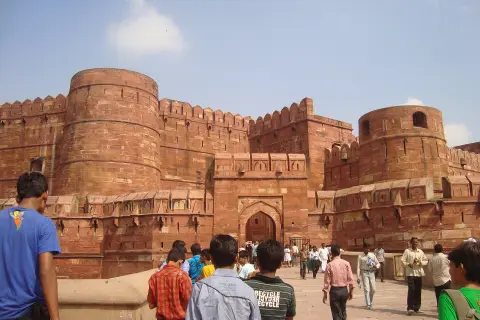
Welcome to Agra Fort. Before we go in, look up at these walls. They are red sandstone, more than two kilometres around, and they were built to impress as much as to protect. Inside, the mood changes completely. You will walk from heavy red halls into airy white marble pavilions, from Akbar's world into Shah Jahan's. This is where emperors held court, received ambassadors and watched elephant fights on the riverbank. It is also where one of them spent his final years as a prisoner. Keep your eyes open for the Taj Mahal. It appears in the distance, framed by arches, more than once on our walk.
The story of Agra Fort
There was a fort on this bend of the Yamuna long before the Mughals. But the fort you see was largely the work of the emperor Akbar, who rebuilt it in red sandstone between 1565 and 1573, when Agra was the capital of his growing empire.
His grandson Shah Jahan had different taste. He loved white marble, and in the 1630s and 1640s he pulled down several older buildings and added marble halls and palaces: the Diwan-i-Am for public audiences, the Diwan-i-Khas for private ones, the Khas Mahal, the Sheesh Mahal and the elegant tower called the Musamman Burj. Several of these rose where Akbar's red stone buildings had stood, so the fort you walk through today is a layered record of three generations of emperors.
In 1658, Shah Jahan's son Aurangzeb seized the throne and kept his father confined within the fort. Shah Jahan lived here until his death in 1666, and tradition holds that he spent his days looking across the river at the tomb of his wife. Later the fort passed through the hands of the Marathas and then the British. UNESCO inscribed it as a World Heritage Site in 1983. Part of it is still used by the Indian Army and remains closed to visitors.
The setting
The fort covers about 38 hectares on the west bank of the Yamuna, roughly two and a half kilometres upstream from the Taj Mahal. It is shaped like a half moon, with its flat side facing the river. Visitors enter from the south through the Amar Singh Gate, climbing a sloping ramp built so that elephants could walk up and attackers would be slowed down. Inside, the buildings fall into layers of time. Akbar's red sandstone palaces stand near the entrance, with carved brackets and Hindu and Central Asian motifs. Shah Jahan's marble pavilions line the river wall, with terraces, fountains and the Anguri Bagh, a small formal garden.
Why it matters
Agra Fort is the best place in India to see how Mughal court life actually worked. It is a working palace, not a museum, and it shows the change in style from Akbar's robust red stone to Shah Jahan's refined marble. Together with the Taj Mahal and Fatehpur Sikri, it forms a triangle of World Heritage Sites that tells the story of the Mughal golden age. And it is far less crowded than the Taj, so you can sit in its marble halls and imagine the court around you.
Your walk-through
The stops a guide would take you to, in order.
-
1
Amar Singh Gate
We start at the visitor entrance on the south side. Walk up the ramp slowly and notice the sharp turns. They were designed to stop charging elephants and to trap an enemy between walls. Look up for the bright blue tile work that survives on the gateway. Two moats once guarded this side of the fort, though today you will see only dry ditches.
-
2
Jahangiri Mahal
This big red palace was built by Akbar, traditionally for his son Jahangir. It is the largest house still standing in the fort. Look at the carved stone brackets and the balconies. Many of the patterns are borrowed from Hindu and Gujarati buildings, a sign of Akbar's mixed court. Outside, look for a huge round stone basin, often called Jahangir's bath, carved from a single block.
-
3
Khas Mahal and Anguri Bagh
Now we cross into Shah Jahan's world. The Khas Mahal is a white marble pavilion where the emperor rested and slept. In front of it lies the Anguri Bagh, a small geometric garden. Its name means grape garden. Stand on the terrace and look out at the river. Two golden-roofed pavilions sit on either side, said to have been for the emperor's daughters.
-
4
Musamman Burj
This octagonal marble tower juts out over the river wall. It is delicate, with inlaid flowers and a small fountain. This is where Shah Jahan is believed to have spent his last years under house arrest. Look through the arches to the east. There, across the curve of the Yamuna, is the Taj Mahal. On a clear day the view is unforgettable.
-
5
Diwan-i-Khas
Next door is the hall of private audience, where the emperor met nobles and foreign envoys. It is open on one side, with fine marble columns. Out on the terrace you will see a black stone throne. It was made for Jahangir, Akbar's son. From here, the emperor could watch the river and the open ground below.
-
6
Diwan-i-Am
We finish in the hall of public audience. It is a long, many-columned hall where ordinary subjects came to see the emperor. Walk to the centre and look at the raised marble alcove. That is where he sat, high above the crowd. Notice how the scalloped arches repeat into the distance. On a quiet afternoon the hall echoes softly, and it is easy to picture the court.
Things you might not know
- Akbar rebuilt the fort in red sandstone over about eight years, from 1565 to 1573.
- The fort covers about 38 hectares, and part of it is still used by the Indian Army.
- Visitors enter through the Amar Singh Gate; the grand Delhi Gate on the west is closed to the public.
Researched November 2026 from: whc.unesco.org, en.wikipedia.org, agra.nic.in, tajmahal.gov.in. Fees and hours change, so check on the day.