⭐ Must-see · East bank of the Yamuna, 4 km from central Agra
Tomb of Itimad-ud-Daulah
The jewel box that showed the way to the Taj
🎧 Listen to this guide · about 5 min
Pop your earphones in and we'll walk you round.
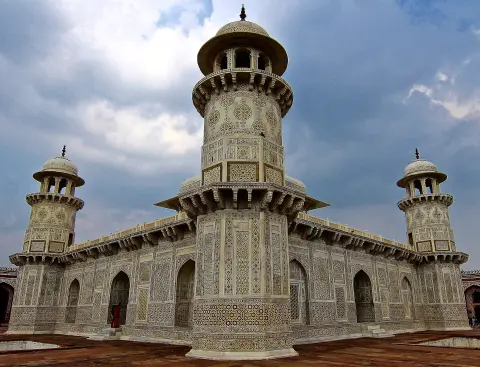
Welcome to the tomb of Itimad-ud-Daulah. People call it the Baby Taj, but I like to think of it as a jewel box. It is small, almost intimate, and every surface is covered in pattern: flowers, cypress trees, wine cups and geometric stars, all set into white marble with coloured stone. After the size of the Taj, this is a lovely change of pace. It is quiet here. The garden is green, the river runs past the back wall, and you can get close enough to touch the patterns with your eyes. Take your time.
The story of Tomb of Itimad-ud-Daulah
This tomb was built by one of the most powerful women in Mughal history, the empress Nur Jahan, wife of the emperor Jahangir. Her father, Mirza Ghiyas Beg, was a Persian who had come to India and risen high at the Mughal court. Jahangir gave him the title Itimad-ud-Daulah, meaning pillar of the state, and made him chief minister. Ghiyas Beg's daughter, born Mehr-un-Nissa, married Jahangir in 1611 and was given the title Nur Jahan, light of the world. She became one of the most influential figures at court, issuing orders and even coins in her own name.
When he died in 1622, Nur Jahan began this tomb for him and for her mother, Asmat Begum, who had died shortly before. The work was finished by 1628.
The family connection runs straight to the Taj Mahal. Ghiyas Beg's son was Asaf Khan, and Asaf Khan's daughter was Mumtaz Mahal. So the man buried here was the grandfather of the woman for whom the Taj was built. The tomb is also a turning point in style. It is often described as the first Mughal building made entirely of white marble, and its inlay work points directly toward the great tomb that would rise downstream a few years later.
The setting
The tomb stands on the east bank of the Yamuna, in the middle of a walled charbagh garden, divided into four by raised walkways and water channels. The tomb itself sits on a low red sandstone platform. It is square, with a short octagonal tower at each corner, and instead of a big dome it has a small pavilion on the roof with a curved canopy. The outer walls are covered in pietra dura, coloured stone set into marble, and in some places there is painted decoration inside. Fine marble screens filter the light into the inner chambers. At the back, a gateway opens onto a terrace above the river.
Why it matters
This tomb is the bridge between Akbar's red sandstone and Shah Jahan's white marble. Walking through it, you see the Mughal style changing, becoming finer, more delicate and more Persian in its taste. It also honours Nur Jahan, a remarkable woman who held real political power. The garden was restored by the Archaeological Survey of India and the World Monuments Fund, and it gives you a sense of how these riverside tombs once looked. It is also, quite simply, one of the most beautiful small buildings in India.
Your walk-through
The stops a guide would take you to, in order.
-
1
The east gateway
Enter through the red sandstone gate and pause. From here you see the tomb framed perfectly at the end of the garden path. Notice how small it is compared with the Taj. That smallness is part of its charm. The decoration of the gate is a preview of what is to come, with inlaid white stars on red stone.
-
2
The garden walk
Walk along the raised path toward the tomb. The garden is divided into four, with water channels running down the centre. This is the paradise garden idea again. Look at how the tomb sits on a low platform, not a high one like the Taj. It feels closer to the ground, more human in scale.
-
3
The outer walls
Now come close to the walls. Look at the inlay. You will find wine cups, vases with flowers, cypress trees and fruit. Many of these are Persian motifs, a reminder of the family's roots in Iran. The stones include yellow, brown and black. Some say this was the first Mughal building where pietra dura was used on such a scale.
-
4
The central chamber
Step inside. In the middle are the yellow stone cenotaphs of Itimad-ud-Daulah and his wife. Look up at the painted ceilings and the soft light through the marble screens. Several other family members are buried in the side rooms. Please take shoes off where asked and keep your voice gentle.
-
5
The river terrace
Walk round to the back, where a pavilion opens onto the Yamuna. Look downstream to the right. On a clear day you can just see the Taj Mahal in the distance. It is a quiet spot. Imagine boats arriving at the water steps, as they once did, bringing visitors to this family tomb.
Things you might not know
- The tomb was built between 1622 and 1628 by the empress Nur Jahan.
- Itimad-ud-Daulah was the grandfather of Mumtaz Mahal, for whom the Taj Mahal was built.
- It is often described as the first Mughal building made entirely of white marble.
Researched November 2026 from: en.wikipedia.org, tajmahal.gov.in, wmf.org. Fees and hours change, so check on the day.