💎 Hidden gem · Sikandra, 9 km from central Agra
Akbar's Tomb, Sikandra
The great emperor's tomb in a garden of deer
🎧 Listen to this guide · about 5 min
Pop your earphones in and we'll walk you round.
Welcome to Sikandra, the resting place of Akbar, the greatest of the Mughal emperors. After the crowds of the Taj, this place feels open and calm. The garden is enormous, and you will often see blackbuck and other deer grazing on the lawns. Ahead of you is a gateway decorated with bold patterns of coloured stone, and beyond it a tomb that looks nothing like the Taj. It rises in tiers, like a stepped pyramid of red sandstone, topped with white marble. It is grand, a little strange and very memorable. Let us walk in.
The story of Akbar's Tomb, Sikandra
Akbar ruled from 1556 to 1605. He had come to the throne at just thirteen years old. He expanded the empire across much of the subcontinent, built Agra Fort and Fatehpur Sikri, and was famous for his curiosity about other religions. He died in Agra in October 1605.
His son Jahangir took charge of building his father's tomb here at Sikandra, on the road to Delhi. The place takes its name from Sultan Sikandar Lodi, who ruled from Agra in the early sixteenth century, long before the Mughals arrived. The work ran from 1605 to about 1613. Jahangir wrote that he was unhappy with the first designs and had parts rebuilt to his taste.
The tomb has suffered. In 1688, during a rebellion against Aurangzeb, Jat forces led by Raja Ram raided Sikandra, damaged the tomb and, according to accounts, desecrated Akbar's grave. Much later, in the early twentieth century, the British viceroy Lord Curzon ordered a major restoration, completed in 1905. Today the tomb and its garden are protected by the Archaeological Survey of India, and they remain among the best kept monuments in Agra. Akbar's wife, Mariam-uz-Zamani, the mother of Jahangir, has her own tomb nearby, and it can be visited separately.
The setting
The tomb stands in the middle of a huge walled garden covering about 119 acres, divided in the classic four-part plan by wide causeways. Visitors enter through the southern gate, a massive structure covered in inlaid geometric and floral patterns, with four white marble minarets rising from its roof. A long path leads to the tomb. The mausoleum has several storeys, each smaller than the one below, with open arcades and small pavilions. The top level is a white marble courtyard open to the sky, holding a carved cenotaph. The real grave lies deep below, in a dim vaulted chamber reached by a sloping passage.
Why it matters
Akbar's tomb shows Mughal architecture at a moment of change, between the red stone of Akbar's own reign and the marble world of Shah Jahan. Its gateway, with its marble minarets, points toward the Taj. It is also a place to reflect on Akbar himself, a ruler remembered for his interest in many faiths and his building of an empire that shaped India for centuries. The calm of the garden today makes it one of the most restful places in Agra.
Your walk-through
The stops a guide would take you to, in order.
-
1
The southern gateway
Stop in front of the gate. Look at the bold patterns of white, black and yellow stone inlaid into the red sandstone. Look up at the four white marble minarets on the corners of the roof. Gates like this, with minarets, were new in Mughal design, and the idea later shaped the Taj Mahal.
-
2
The garden causeway
Walk along the long, raised causeway toward the tomb. Look out over the lawns on either side. You will often see blackbuck, with their spiral horns, and other deer grazing. Please keep your distance and do not feed them. Notice the scale of the garden. It was meant to show Akbar's greatness.
-
3
The tomb's facade
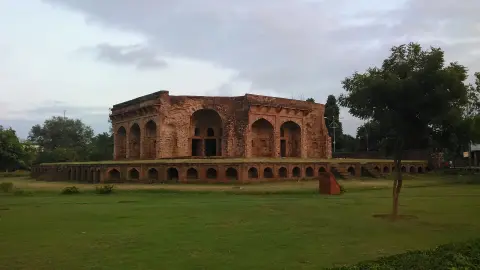
Now look at the tomb from close up. It rises in tiers, with arcades and small domed pavilions on each level. It does not have a big central dome, which surprises many visitors. Some historians see influences from Buddhist and Hindu buildings, a reflection of Akbar's open mind.
-
4
The burial chamber
Go down the sloping passage into the vaulted chamber below. It is dim and quiet. Here, beneath the floor, is Akbar's actual grave. Look up at the painted decoration on the vault, partly restored. Please remove your shoes and keep your voice low. Visitors sometimes leave flowers here.
-
5
The view of the upper storeys
Come back out and look up toward the top of the tomb. The highest level is a white marble courtyard, open to the sky, with a carved marble cenotaph and fine marble screens. Access to the upper levels is often restricted, so enjoy it from below. Then take a slow walk back through the garden.
Things you might not know
- The tomb was built by Akbar's son Jahangir between 1605 and about 1613.
- The garden around the tomb covers about 119 acres.
- Lord Curzon ordered a major restoration of the tomb, completed in 1905.
Researched November 2026 from: en.wikipedia.org, tajmahal.gov.in. Fees and hours change, so check on the day.