💎 Hidden gem · Kerameikos, 2 km from central Athens
Kerameikos
The ancient city gate and the street of remembrance
🎧 Listen to this guide · about 5 min
Pop your earphones in and we'll walk you round.
Welcome to Kerameikos. Few visitors come here, and that is part of what makes it special. This was a place of work and a place of mourning. Potters lived and worked in this district, and its name gives us the English word ceramic. Just outside the old city walls, Athenians buried their dead for well over a thousand years. Please walk respectfully. These are graves, some of them very personal. You will see carved figures of families saying farewell, an ancient stream lined with reeds, and the foundations of the city's greatest gate. Tortoises often wander among the stones. It is calm and green, a place to slow down and reflect on how people in ancient Athens remembered those they had lost.
The story of Kerameikos
The area lay beside a small river, the Eridanos, and was used for burials as early as the third millennium BC. By around 1200 BC it had become an organised cemetery. The potters' workshops inside the walls gave the district its name, and many of the famous painted vases of early Athens were found in its graves.
After the Persians sacked Athens in 480 BC, the city built a new wall in a hurry in 478 BC, under the leader Themistocles. Gravestones and statues were built straight into it. Two great gates opened here: the Dipylon, the city's main entrance, and the Sacred Gate, where the Sacred Way began its road to Eleusis. Outside the walls lay the state burial ground for citizens killed in war. Here, in 431 BC, Pericles gave his famous funeral oration, as recorded by Thucydides.
The Roman general Sulla's army destroyed much of the area in 86 BC. The site was rediscovered in 1863. Greek archaeologists began digging in 1870, and the German Archaeological Institute has excavated here since 1913. Building the nearby metro station uncovered a mass grave linked by many scholars to the plague of 430 to 426 BC.
The setting
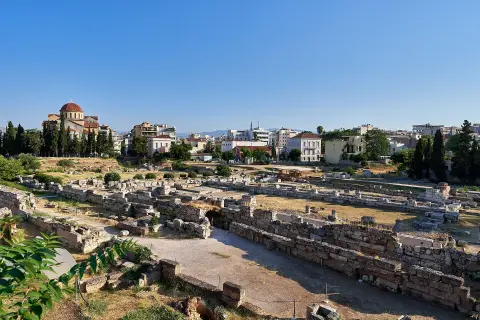
Kerameikos lies in a hollow northwest of the Ancient Agora, lower than the modern streets around it. The ancient ground level is several metres below today's pavement. The remains of the Themistoclean wall cross the site, with the Sacred Gate and the Dipylon Gate side by side. Between them stands the Pompeion, a building used to prepare the great processions. Outside the wall, the Street of Tombs runs west, lined with family burial plots and grave markers. Reeds and wild plants grow along the Eridanos stream. A small museum near the entrance holds sculpture and grave goods.
Why it matters
Kerameikos shows how classical Athens understood loss, honour and memory. The grave reliefs are some of the most tender works of Greek art, with families clasping hands in a last farewell. The public burial ground for war dead helped shape how a democracy remembers its citizens. It is also a rare place in Athens where you can stand on the actual ancient ground level, at the edge of the old city, and see how the city met the road beyond.
Your walk-through
The stops a guide would take you to, in order.
-
1
Kerameikos Museum
Begin in the small museum. Look at the grave markers and vases found here. The kouros statues and stelai are carved with real care. Some show a seated woman reaching for the hand of someone standing; this gesture of farewell appears again and again. There are also small objects left with children. Take your time with them, and remember they were made for grief.
-
2
Street of Tombs
Walk out along the Street of Tombs. Family plots line both sides. Many of the monuments here are casts, with originals in museums, but they stand in their real places. Look for a carved bull on a high base, marking a family plot, and the relief of a woman named Hegeso choosing jewellery from a box held by her maid. The original is in the National Archaeological Museum.
-
3
Sacred Gate and the Eridanos
Now come to the Sacred Gate, where the Eridanos stream flowed out through the wall. Here began the Sacred Way, the road to Eleusis, used by processions for the Eleusinian Mysteries. Notice how the stream channel and the road passed side by side. Frogs and turtles still live in the water among the reeds.
-
4
The Pompeion
Between the two gates are the foundations of the Pompeion. Its name comes from the Greek word for procession. Here the great Panathenaic procession was organised before it set off through the city to the Acropolis. Later, the building also hosted feasts. Look for its long courtyard outline in the ground.
-
5
Dipylon Gate
Finally, the Dipylon, the double gate and the main entrance to ancient Athens. It was the largest gate in the city. Just beyond it began the road to the Academy of Plato and the state burial ground, where those who died for the city were honoured and where Pericles spoke in 431 BC. Pause here for a quiet moment before you leave.
Things you might not know
- The English word ceramic comes from Kerameikos, the potters' quarter of Athens.
- The Themistoclean wall of 478 BC was built so fast that old gravestones were used as building blocks.
- Work on the Kerameikos metro station revealed a mass grave widely linked to the plague of Athens.
Researched November 2026 from: en.wikipedia.org, en.wikipedia.org. Fees and hours change, so check on the day.