⭐ Must-see · Acropolis, 1 km from central Athens
The Acropolis and Parthenon
Marble, light and the rock where Athens began
🎧 Listen to this guide · about 6 min
Pop your earphones in and we'll walk you round.
Welcome to the Acropolis. Look up from almost any street in Athens and you see this rock, flat-topped and pale, with the Parthenon resting on it like a crown. Today we climb it together. The path is old and the marble underfoot is smooth from millions of feet, so take your time. As we rise, the noise of the city fades and the wind picks up. You will see the sea glinting toward Piraeus and the mountains that ring the basin. People have climbed this hill for more than three thousand years, to pray, to defend, to celebrate. Now it is your turn. Keep your eyes open for small things too: a carved drum lying in the grass, a worn step, the honey colour the stone takes in the late light.
The story of The Acropolis and Parthenon
The rock rises about 150 metres above sea level, and it was a fortified stronghold in the Bronze Age. Over the centuries it became the sacred home of Athena, the city's protector. In 480 BC the Persian army sacked Athens and burned the temples here. For a generation, the ruins were left as they were.
Then, in the mid fifth century BC, the statesman Pericles launched a vast building programme. The architects Ictinus and Callicrates, working with the sculptor Phidias, raised the Parthenon from about 447 BC. Mnesicles began the great gateway, the Propylaea, in 437 BC. The small Temple of Athena Nike and the Erechtheion followed in the 420s and 410s BC. Inside the Parthenon stood Phidias's enormous statue of Athena, made of gold and ivory.
The buildings outlived ancient Greece. The Parthenon became a church, then a mosque. In 1687, during a Venetian siege, the Ottoman garrison stored gunpowder inside it. A Venetian shell struck, and the explosion blew out its centre. In the early 1800s, agents of Lord Elgin removed much of the surviving sculpture to Britain. UNESCO listed the site in 1987, and a careful restoration project, begun in 1975, continues today.
The setting
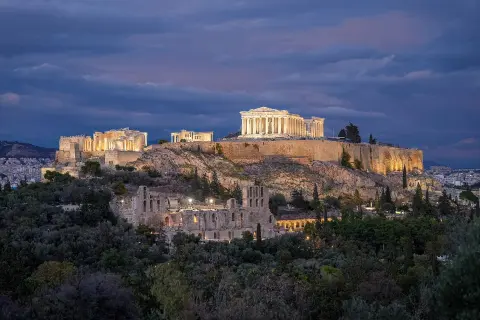
The Acropolis is a limestone outcrop covering about three hectares, with cliffs on almost every side. The only easy approach is from the west, which is why the entrance and the Propylaea face that way. Once through the gate, the Parthenon dominates the south side of the summit. It is a Doric temple of Pentelic marble, with eight columns across each end and seventeen along each side. Nothing in it is quite straight: the floor curves gently upward at the centre and the columns swell and lean slightly inward, so the whole building looks alive rather than rigid. To the north stands the Erechtheion, an irregular temple on several levels. On the slopes below lie the Theatre of Dionysus and the Odeon of Herodes Atticus.
Why it matters
For many people, the Parthenon is simply the image of classical Greece. Its proportions have been studied and copied in banks, museums and parliaments around the world. Yet it is also a living work site. The restoration team uses original fragments wherever possible, titanium joints that will not rust, and new marble only where it is needed. The site also sits at the heart of a long debate about the Parthenon sculptures in the British Museum, which Greece has asked to have returned. Standing here, you are looking at a monument that is still being cared for, argued over and loved.
Your walk-through
The stops a guide would take you to, in order.
-
1
Propylaea
This is the gateway, the grand entrance to the sacred hill. Mnesicles designed it in 437 BC, and work stopped around 432 BC, so parts were never finished. Look for rough stone knobs left on some blocks; they were for lifting and were meant to be cut away later. As you pass between the columns, imagine the Panathenaic procession climbing this way, with music, animals for sacrifice and a new robe for Athena.
-
2
Temple of Athena Nike
Turn to your right, on the bastion jutting out over the slope. This small, graceful temple honoured Athena as the bringer of victory. It was finished in the 420s BC. It has been taken down and rebuilt more than once in modern times, most recently in a restoration completed in 2010. From the bastion, legend says, old King Aegeus watched for his son's ship and threw himself down in grief.
-
3
The Parthenon, west front
Now the Parthenon itself. Stand back and let your eye run along the steps. See how they rise ever so slightly toward the middle? The builders curved them on purpose, so the long lines would not look like they sag. The west pediment once showed Athena and Poseidon competing for the city. Most of the surviving sculpture is now in the Acropolis Museum or in London, so what you see here is the bare, beautiful frame.
-
4
The Erechtheion and the Caryatids
Walk to the north side. The Erechtheion is the strangest building here, stepped across uneven ground and dedicated to several gods and heroes. On its south side six young women hold up the roof. These Caryatids are copies; five originals are safe in the museum and one is in the British Museum. Next to the temple grows an olive tree, recalling Athena's gift to the city in the old myth.
-
5
The Belvedere and eastern edge
Finally, come to the eastern tip of the rock, where the Greek flag flies. From here you look straight over Plaka and Anafiotika, toward the Panathenaic Stadium and Mount Lycabettus. On a clear day you can follow the line of the coast. Take a quiet moment. This is the view the Athenians knew, even if the city below has grown beyond anything they could imagine.
Things you might not know
- The Parthenon was used as a gunpowder store in 1687, and a Venetian shell caused the explosion that wrecked it.
- The Parthenon's columns lean slightly inward and its floor curves upward, so that it does not look flat or sagging.
- The restoration uses titanium joints because, unlike the old iron clamps, they do not rust and split the marble.
Researched November 2026 from: whc.unesco.org, en.wikipedia.org, en.wikipedia.org. Fees and hours change, so check on the day.