🚗 Day trip · Sounion, East Attica, 70 km from central Athens
Temple of Poseidon, Cape Sounion
Marble columns above the sea at the end of Attica
🎧 Listen to this guide · about 5 min
Pop your earphones in and we'll walk you round.
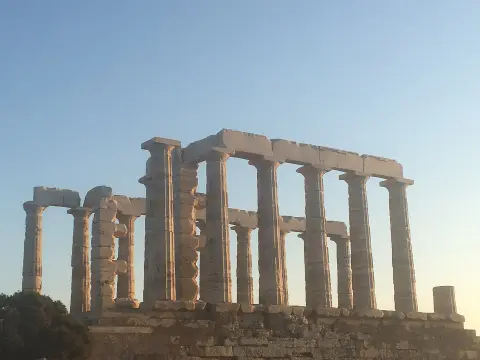
Welcome to Cape Sounion, the southern tip of the Attic peninsula. We have driven along the coast to get here, with the sea on our right almost the whole way. Now look up. On the top of the headland, white columns stand against the sky, with the water glittering far below. This is the Temple of Poseidon, god of the sea. Sailors leaving Athens saw it as their last sight of home, and those returning knew they were nearly back. The wind is often strong up here, so hold on to your hat. Walk around the temple slowly and watch the light change. If you can stay for sunset, you will see why people come from all over the world.
The story of Temple of Poseidon, Cape Sounion
Sounion was a sacred place long before the temple you see. An earlier Archaic temple to Poseidon stood here, and it was probably destroyed by the Persian army around 480 BC, during the invasion of King Xerxes. Large marble statues of young men, called kouroi, dating from around 600 BC, were found here and are now in the National Archaeological Museum in Athens.
The present temple was built around 444 to 440 BC, at the time when Pericles led Athens and the Parthenon was rising. Some scholars think the same unnamed architect designed this temple and the Temple of Hephaestus in Athens, though that remains uncertain. It was made mostly of local marble and held a bronze cult statue of Poseidon. Its position also served a practical purpose: from here the Athenians could watch the sea lanes to and from their port at Piraeus.
Legend says that King Aegeus waited on this cape for his son Theseus to return from Crete. Seeing black sails, he believed his son was dead and threw himself into the sea, which, so the story goes, took his name: the Aegean. In 1825 two columns fell, and pieces later travelled to Venice and England. The site was excavated in the late nineteenth and early twentieth centuries.
The setting
The temple stands on a rocky headland that drops steeply to the sea on three sides, about 60 metres above the water. It is a Doric temple with columns along all sides, and a row of them still stands, gleaming against the blue. The marble is local, from nearby quarries, and the columns are slimmer than many Doric temples. Around it lie the remains of a fortification wall and buildings. On a lower hill nearby are the foundations of a sanctuary of Athena. Below are coves with beaches, and on a clear day you can see the islands of Kea and Kythnos.
Why it matters
Sounion shows how the Athenians placed their temples within the landscape. It was both a religious and a strategic site, protecting the city's crucial sea routes. For centuries it inspired travellers and poets, including Lord Byron, and it became a pilgrimage stop on the Grand Tour. Today it remains one of the most visited ancient sites in Greece and a classic sunset destination for Athenians.
Your walk-through
The stops a guide would take you to, in order.
-
1
The approach path
Start walking up the path from the entrance. Do not rush; let the temple reveal itself between the bushes. Notice the wild thyme and the white rocks. This climb gives you the same view ancient sailors had: the columns slowly rising against the sky. Pause halfway and look back at the sea.
-
2
The temple's south side
Now stand beside the temple, behind the rope. Look up at the columns. They are fluted Doric columns, slimmer than usual, perhaps so they would stand out elegantly from far away. The marble is local, and it has weathered to a soft white. On a sunny day it almost glows. Imagine the bronze Poseidon inside, many metres tall.
-
3
Carved names on the columns
Look closely at the columns, especially near the base, and you will see names carved into the marble by visitors of past centuries. One is said to be the name of Lord Byron, who loved this place. Today, of course, carving anything is forbidden. Treat the stone gently; it has survived for nearly 2,500 years.
-
4
Western edge viewpoint
Walk to the western edge of the site, where the cliff falls away. This is where many people gather for sunset. The sun sinks into the sea between the islands. Legend says King Aegeus jumped from this cape, giving his name to the Aegean. Stand here quietly as the light turns gold and then pink across the water.
-
5
Sanctuary of Athena
If you have time, look toward the lower hill to the northeast. There stood a sanctuary of Athena Sounias, only foundations now. It is a reminder that Sounion honoured both of the gods who competed for Athens: Poseidon of the sea and Athena of wisdom. From here, the temple of Poseidon looks even more striking on its cliff.
Things you might not know
- The present temple was built around 444–440 BC, replacing an earlier temple likely destroyed by the Persians.
- Two of its columns fell in 1825; drums from them are now at Chatsworth House and the British Museum, and one column went to Venice.
- Legend links this cape to King Aegeus, whose name is given to the Aegean Sea.
Researched November 2026 from: en.wikipedia.org, en.wikipedia.org. Fees and hours change, so check on the day.