⭐ Must-see · Downtown / Beacon Hill, 1 km from central Boston
Boston Common and Public Garden
Cow pasture, parade ground and the city's green front lawn
🎧 Listen to this guide · about 6 min
Pop your earphones in and we'll walk you round.
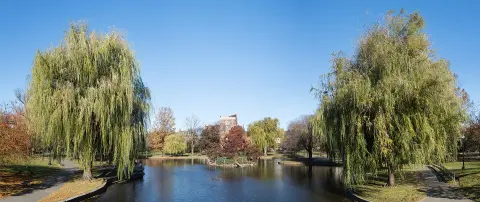
Welcome to the Common. This is where Boston comes to breathe. Office workers cut across it at lunch, children chase pigeons near the fountain, and the gold dome of the State House shines from the top of the hill. You are standing on land that has been public since 1634, which makes it the oldest city park in the country. Across Charles Street lies its younger, prettier sister, the Public Garden, with a lagoon, weeping willows and boats shaped like swans. Together they make the green heart of the city. We will walk from the rough, historic Common into the polished Garden, and you will feel the change under your feet.
The story of Boston Common and Public Garden
In 1634 the Puritan settlers bought this land from William Blaxton, the first European to live on the peninsula, for thirty pounds. It became common ground for the whole town. Families grazed their cows here for nearly two centuries, until Mayor Harrison Gray Otis banned cattle in 1830.
The Common also had a harder side. Public executions were held here until 1817. In 1660 the Quaker Mary Dyer was hanged here for her faith. Before the Revolution, British soldiers camped on this grass, and in April 1775 troops set out from here toward Lexington and Concord. Much later, in 1979, Pope John Paul II said Mass here for a crowd of about 400,000 people.
The Public Garden came later. In 1837 it became the first public botanical garden in the United States, laid out on filled marshland at the edge of the Back Bay. In 1877 a shipbuilder named Robert Paget launched pedal-powered Swan Boats on its lagoon, inspired by the opera Lohengrin. His family still runs them today. In 1965 Martin Luther King Jr. led a rally here against segregation in Boston's schools. The Common has been a stage for speeches, protests and celebrations ever since, from the Revolution to the present day.
The setting
The Common covers about 50 acres of rolling lawns, paths and old trees, bordered by Tremont, Park, Beacon, Charles and Boylston Streets. It is a working park, a little worn and very lived in. Flagstaff Hill rises near the middle, crowned by a Civil War monument. The Frog Pond sits in a hollow below the State House, a skating rink in winter and a spray pool in summer. Cross Charles Street and the mood shifts. The Public Garden, about 24 acres, is formal and Victorian, with flower beds, specimen trees and a curving lagoon. A small footbridge from 1867 crosses the water, and a bronze George Washington on horseback faces Commonwealth Avenue.
Why it matters
Boston grew up around this open space, and it has never been built over. That alone is rare for a city of this age. The Common is still where Boston gathers, to protest, to celebrate and to mourn. It is the official start of the Freedom Trail, so many visitors take their first step into the city's history right here. The Public Garden, meanwhile, set a pattern for American public gardens. Generations of children know it through the book Make Way for Ducklings, and the Swan Boats are one of the oldest continuously run family businesses in the city.
Your walk-through
The stops a guide would take you to, in order.
-
1
Boston Common Visitor Center, Tremont Street
Start at the small visitor center on Tremont Street. This is the official beginning of the Freedom Trail, and the red brick line in the pavement starts nearby. Pick up a map here if you want one. Then look up the slope toward Beacon Hill. The trail runs about two and a half miles from this spot to Charlestown, past sixteen historic sites. Today we stay on the grass for a while before the history pulls us north.
-
2
Robert Gould Shaw and 54th Regiment Memorial
Across from the State House stands a bronze relief by Augustus Saint-Gaudens, unveiled in 1897. It honors Colonel Robert Gould Shaw and the men of the 54th Massachusetts Infantry, one of the first Black regiments raised in the North during the Civil War. Many of them died in the assault on Fort Wagner in South Carolina in 1863, Shaw among them. Take a quiet moment here. Look at the faces of the soldiers, each one modelled with care.
-
3
Frog Pond
Walk down the hill to the Frog Pond. In winter it becomes an outdoor skating rink, usually from about mid-November into March, with skate rental on site. In summer it turns into a shallow spray pool full of children. In between, it is a reflecting pool for the State House dome above. Bostonians have been gathering around this little hollow for generations. If you are here on a cold evening, the lights and music make it the warmest spot on the Common.
-
4
Central Burying Ground
On the Boylston Street side, behind an iron fence, lies the Central Burying Ground, opened in 1756. The painter Gilbert Stuart is buried here. He made the portrait of George Washington that appears on the one-dollar bill. The composer William Billings rests here too. The stones are old slate, carved with winged skulls and willows. Please stay on the paths, and keep your voice low.
-
5
Lagoon bridge, Public Garden
Cross Charles Street into the Public Garden and walk to the small bridge over the lagoon. It opened in 1867 and was once billed as the shortest suspension bridge in the world, though it has since been reinforced. Stand in the middle. To one side you see the willows trailing in the water. To the other, the Swan Boats glide past in the warmer months, pedalled from behind by a driver who sits inside the swan.
-
6
Make Way for Ducklings
Near the corner of Beacon and Charles Streets you will find Mrs. Mallard and her eight ducklings in bronze, all in a row. Nancy Schön made them in 1987, based on Robert McCloskey's 1941 picture book about a duck family that moves to this very garden. Children climb on them, and the ducklings are often dressed up for holidays and big games. Count them. Jack, Kack, Lack, Mack, Nack, Ouack, Pack and Quack.
Things you might not know
- Cows were allowed to graze on the Common until 1830.
- The Public Garden, founded in 1837, was the first public botanical garden in the United States.
- The Swan Boats have been run by the same Paget family since 1877.
Researched November 2026 from: en.wikipedia.org, en.wikipedia.org, thefreedomtrail.org. Fees and hours change, so check on the day.