🚗 Day trip · Concord, 33 km from central Boston
Old North Bridge, Minute Man National Historical Park
Where the Revolution's first organised volley was fired
🎧 Listen to this guide · about 6 min
Pop your earphones in and we'll walk you round.
Welcome to Concord, a small New England town about forty minutes west of Boston. We are walking to a simple wooden bridge over a slow river. It looks peaceful now, with fields and trees around it. But on the morning of 19 April 1775, men from these farms faced British soldiers here and fired, and men on both sides died. This was the first day of the American Revolutionary War. The bridge is part of Minute Man National Historical Park. We will walk in quietly, read the markers and remember the people who were here.
The story of Old North Bridge, Minute Man National Historical Park
In April 1775 British commanders in Boston learned that colonists had stored military supplies in Concord. On the night of 18 April, about 700 British troops marched out of the city. Riders, including Paul Revere and William Dawes, spread the alarm. At dawn on 19 April, British soldiers met local militia on Lexington Green. Shots were fired, and eight colonists were killed.
The British then marched on to Concord, about six miles further. They searched for supplies, including at the farm of Colonel James Barrett. Around 400 colonial militia and minutemen gathered on the hill above the North Bridge. About 90 British soldiers held the bridge. When the colonists saw smoke rising from the town, they marched down. Shots were fired. Major John Buttrick of Concord ordered his men to return fire. Three British soldiers were killed and nine wounded. Two Americans were killed, including Captain Isaac Davis of Acton.
The British withdrew to Boston under fire along the road, with heavy losses on both sides. In 1837 Ralph Waldo Emerson wrote the Concord Hymn for a monument here, calling it the shot heard round the world. By the end of the day, about 49 colonists and 73 British soldiers had been killed. Minute Man National Historical Park was created in 1959 to protect the bridge and the road.
The setting
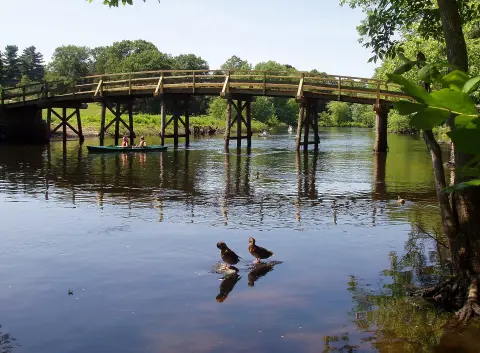
The North Bridge spans the Concord River, which moves slowly between grassy banks. The present wooden bridge was built in 1956 as an approximate replica of the 1760 bridge, and was restored in 2005. On the near bank stands a stone obelisk from 1836, and close by a small grave for British soldiers. Across the bridge stands Daniel Chester French's bronze Minute Man statue, unveiled in 1875. A path climbs the hill to the North Bridge Visitor Center, in a brick mansion. Nearby is the Old Manse, home of the Emerson family. Further east, the five-mile Battle Road Trail follows the British retreat.
Why it matters
The fight at the North Bridge was the first time colonial militia were ordered to fire on British soldiers, and they did so as an organised force. It turned a protest into a war. Today the site helps visitors understand the choices ordinary farmers faced and the cost to families on both sides. It is a place of national memory, but also a local one. Each April, around Patriots' Day, people gather here for commemorations. Most days, it is quiet, and visitors walk with care.
Your walk-through
The stops a guide would take you to, in order.
-
1
Parking area and Monument Street path
From the parking lot on Monument Street, walk down the tree-lined path toward the river. This is the route the British soldiers took to hold the bridge. Look at the old stone walls in the fields. They marked farms that were here in 1775. The path is short. As you walk, picture the morning, with the British in red coats and the militia gathering on the hill across the water.
-
2
1836 Battle Monument
On the near bank stands a granite obelisk, raised in 1836 on the British side of the river. Emerson's Concord Hymn was sung at its dedication the next year, on 4 July 1837. Read the inscription. It honours the colonists who fought here. Take a moment. The ground you stand on is where the British soldiers formed up as the militia came down the hill toward them.
-
3
Grave of British soldiers
Near the bridge, by the stone wall, is a small grave. Two British soldiers killed here were buried at this spot. A stone marker from 1910 carries lines of verse by James Russell Lowell. It is not known which of the three British dead lie here. Please pause and be respectful. These were young men far from home, and their families never saw them again.
-
4
North Bridge
Now step onto the bridge. It is a 1956 replica of the bridge that stood here in 1760, restored in 2005. Look down at the slow, brown river. Here the two sides faced each other, close enough to see faces. The British fired first, then the militia returned fire. Within minutes it was over. Stand still and listen to the water and the wind.
-
5
Minute Man statue
Across the bridge stands the Minute Man, a bronze farmer with a musket in one hand and a plough beside him. Daniel Chester French made it for the centennial in 1875. The first lines of Emerson's Concord Hymn are carved on the base. The figure stands for the citizen soldier who left his fields to fight. Many say it was inspired by Captain Isaac Davis, who was killed here.
-
6
North Bridge Visitor Center
Finally, walk up the hill to the North Bridge Visitor Center, in a brick mansion built for the Buttrick family in 1911. From the gardens, look back down toward the bridge. This is roughly where the militia gathered and watched the smoke rising from town. Inside, when open, rangers and exhibits explain the battle. In winter it is often closed, but the grounds stay open.
Things you might not know
- The present bridge is a 1956 replica of the 1760 bridge.
- Three British and two American soldiers were killed in the fight at the bridge.
- Emerson wrote the phrase shot heard round the world for the 1837 monument dedication.
Researched November 2026 from: en.wikipedia.org, nps.gov, nps.gov. Fees and hours change, so check on the day.