🚗 Day trip · Salem, 28 km from central Boston
Salem Maritime National Historical Park
Wharves, sea captains and Salem's golden age of trade
🎧 Listen to this guide · about 6 min
Pop your earphones in and we'll walk you round.
Welcome to Salem, on the North Shore, about half an hour from Boston. Most people come for the witch trials of 1692. But we are going down to the waterfront, to Salem's other story. After the Revolution, ships from this harbour sailed to India, Sumatra and China, and came back loaded with pepper, tea and silk. Their owners built fine houses and grand wharves. Salem Maritime was the first National Historic Site in the United States, and it is free to visit. Breathe in the salt air. Look at the long wharf reaching into the harbour. Let us walk it.
The story of Salem Maritime National Historical Park
Salem's merchants grew rich in the decades after independence. With British trade restrictions gone, they sent ships around the world, especially to the Indian Ocean and East Asia. One of the most successful merchants was Elias Hasket Derby, often said to be one of the wealthiest men in America in his day. His father, Captain Richard Derby, built the Derby House in 1762 as a wedding gift for him.
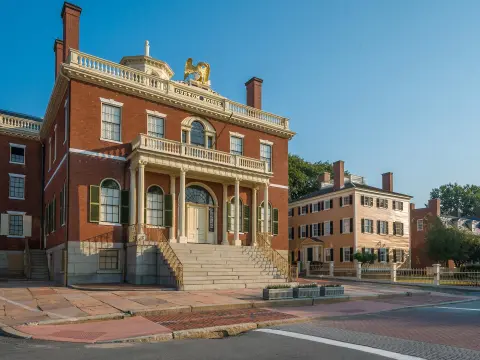
The long Derby Wharf was extended in 1806 to almost half a mile, so large ships could tie up and unload. In 1819 the Custom House was built to collect duties on goods coming in. From 1846 to 1849, the writer Nathaniel Hawthorne worked here as a surveyor of the port. He later wrote about the Custom House, and its eagle, in the introduction to The Scarlet Letter, published in 1850.
Salem's trade declined in the later 1800s, as ships grew too big for its harbour. In 1938 the area became Salem Maritime National Historic Site, the first place given that title. In 2025 it was redesignated a National Historical Park. Salem ships were among the first from America to trade with Sumatra for pepper, and for a time Salem was the leading American port in the pepper trade.
The setting
The park covers about nine acres along the Salem waterfront, with 12 historic structures and a replica tall ship. Derby Wharf stretches far into the harbour, with a small white lighthouse from 1871 at its end. Facing the water on Derby Street stand the brick Custom House with its gold eagle, the Derby House, and the old wooden Narbonne House from the late 1600s. Gardens and warehouses fill the gaps. Moored at Central Wharf is Friendship of Salem, a replica of a ship from 1797, built in 1997. The town of Salem, with its museums and shops, lies just behind.
Why it matters
Salem Maritime shows how a small New England port connected America to the wider world. Its ships brought back spices, porcelain and ideas, and its wealth built universities, museums and houses still standing today. The park helps visitors see that early American history was global, not only local. It is also a calm counterpoint to Salem's crowded witch attractions, especially in October. Many locals walk the wharf at sunset, and for families, it is a free, open-air lesson in history.
Your walk-through
The stops a guide would take you to, in order.
-
1
Salem Armory Regional Visitor Center
Begin at the visitor center on Essex Street, near the train station. Pick up a map and watch the short film about Salem's history if you have time. Rangers can tell you which buildings are open today. Then walk down toward the water along Derby Street, about ten minutes. Notice the old houses on the way, many built by sea captains and merchants.
-
2
Custom House
Stop in front of the brick Custom House, built in 1819. Look up at the gilded eagle on the roof. Nathaniel Hawthorne worked here from 1846 to 1849, and he described the building and its eagle in The Scarlet Letter. Inside, when open, you can see his office and the rooms where duties were collected. Imagine merchants waiting here with papers while ships unloaded outside.
-
3
Derby House
Next, look at the Derby House, a handsome brick home from 1762. Captain Richard Derby built it as a wedding gift for his son, Elias Hasket Derby, who became one of the great merchants of his age. Its simple Georgian style shows wealth without show. When the house is open for tours, you can see how a merchant family lived on the edge of the busy harbour.
-
4
Narbonne House
A short walk away is the Narbonne House, a wooden house dating to around the late 1600s. It is much older and plainer than the Derby House. Ordinary working families lived here for generations, not merchants. Archaeologists dug in its yard and found pieces of everyday life, such as dishes and tools. It is a good reminder that not everyone in Salem grew rich from the sea.
-
5
Friendship of Salem
At Central Wharf you see the tall ship Friendship of Salem. She is a replica of a three-masted trading ship from 1797, built in 1997. The original made 15 voyages to places like China, India and Russia before she was captured by the British in the War of 1812. Look at her rigging and think of a crew sailing for many months to the far side of the world.
-
6
Derby Wharf Light
Finish by walking the length of Derby Wharf, almost half a mile, to the little lighthouse at the end, built in 1871. It is a small square tower, simple and white. From here, look back at the town and out across the harbour. Boats bob at their moorings. In the evening the light glows softly, and the sky over the water turns gold.
Things you might not know
- It was the first National Historic Site in the United States, created in 1938.
- Nathaniel Hawthorne worked in the Custom House from 1846 to 1849.
- Derby Wharf was extended to almost half a mile long in 1806.
Researched November 2026 from: en.wikipedia.org, nps.gov, nps.gov. Fees and hours change, so check on the day.