💎 Hidden gem · Józsefváros, District VIII, 3 km from central Budapest
Fiumei Road Cemetery (Kerepesi Cemetery)
Hungary's national pantheon among old trees
🎧 Listen to this guide · about 5 min
Pop your earphones in and we'll walk you round.
Welcome to the Fiumei Road Cemetery, which most locals still call Kerepesi. This is a burial ground, so we will walk quietly and respectfully. It is also one of the great national cemeteries of Europe. Under these trees lie prime ministers and poets, painters and scientists, revolutionaries and their opponents. Their tombs range from simple stones to enormous mausoleums. Walking here is like walking through a history book of Hungary, chapter by chapter. Many local people come to visit family graves, leave candles, or simply walk in the shade. Keep to the paths, speak softly, and take photographs with care.
The story of Fiumei Road Cemetery (Kerepesi Cemetery)
The cemetery was founded in 1847 on what was then the edge of Pest. The first burial took place in 1849, the year Hungary's war of independence against Habsburg rule was crushed. In 1885 the city declared it a ground of honour, and from then on it became the place to bury the nation's most important figures.
Great monuments followed. The mausoleum of Ferenc Deák, the statesman behind the 1867 Compromise with Austria, was built in 1876 to designs by Kálmán Gerster, with stained glass by Miksa Róth. The vast mausoleum of Lajos Kossuth, leader of the 1848 revolution, followed in 1894, designed by Gerster with sculpture by Alajos Stróbl. Lajos Batthyány, Hungary's first prime minister, executed in 1849, also has a mausoleum here.
In the communist period, the authorities built the Pantheon of the Labour Movement, completed in 1958, and promoted it as the cemetery's centrepiece. After 1989, many other graves came back into focus. Today the National Heritage Institute manages the site as the Fiumei Road National Graveyard.
The setting
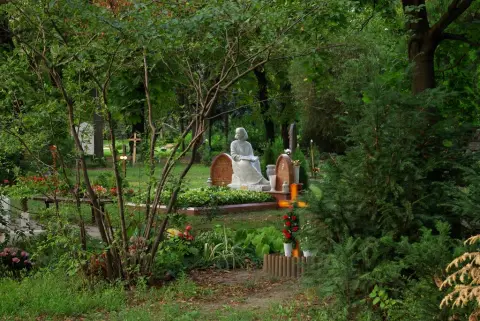
The cemetery covers about 56 hectares, making it one of the largest green spaces in central Pest. Wide avenues lined with old trees divide it into plots. Monumental tombs cluster near the main entrance on Fiumei Road and along the main paths. Further in, the graves become quieter and more overgrown, with ivy on old stones. Sculpture is everywhere: bronze figures, mourning angels, portrait busts. The style of the tombs changes through time, from nineteenth century classical to Art Nouveau to stark communist modernism.
Why it matters
Here you can see how a nation chooses to remember itself. The great figures of the 1848 revolution, the poets who shaped the Hungarian language and the politicians of every era are buried within a short walk of each other. It is also a remarkable open-air gallery of sculpture. For visitors, it offers calm, shade and a deeper understanding of the names on Budapest's streets and squares.
Your walk-through
The stops a guide would take you to, in order.
-
1
Main entrance on Fiumei út
Enter through the main gate. Pick up a map at the office if it is open, or use the boards near the entrance. The cemetery is large, so it helps to choose a few graves to find. Notice how quiet it becomes just a few steps from the traffic.
-
2
Deák Mausoleum
Walk along the main avenue to the mausoleum of Ferenc Deák, built in 1876. Deák was the statesman who negotiated the Compromise of 1867, which created Austria-Hungary. Notice the stained glass by Miksa Róth, one of Hungary's finest glass artists. The mausoleums can be visited inside only on guided walks.
-
3
Batthyány Mausoleum
Nearby is the mausoleum of Lajos Batthyány, Hungary's first prime minister in 1848. After the revolution failed, he was executed in Pest on 6 October 1849. That date is still a national day of mourning in Hungary.
-
4
Kossuth Mausoleum
Now the largest of all, the mausoleum of Lajos Kossuth, leader of the 1848 revolution. He died in exile in Turin in 1894, and his body was brought home for a huge funeral. The tomb, designed by Kálmán Gerster with sculpture by Alajos Stróbl, is heavy, dark and solemn.
-
5
Graves of writers and artists
Wander off the main avenue to find graves of writers and artists. Among those buried here are the novelist Mór Jókai, the poets Endre Ady and Attila József, and the painter Mihály Munkácsy. Locals often leave flowers or candles at these graves, especially on 1 November, All Saints' Day.
-
6
Pantheon of the Labour Movement
Finally, see the Pantheon of the Labour Movement, completed in 1958. This large monument was the centrepiece the communist authorities wanted visitors to see. Today it stands as a piece of history in itself, a reminder of how memory is shaped by those in power.
Things you might not know
- The cemetery was founded in 1847 and the first burial took place in 1849.
- It covers around 56 hectares.
- The National Heritage Institute runs free guided weekend walks, with registration, which are the only way to see inside the mausoleums.
Researched November 2026 from: en.wikipedia.org, en.nori.gov.hu, lonelyplanet.com. Fees and hours change, so check on the day.