⭐ Must-see · Fővám tér, District IX, 1 km from central Budapest
Great Market Hall
Paprika, steel and coloured tiles since 1897
🎧 Listen to this guide · about 5 min
Pop your earphones in and we'll walk you round.
Follow your nose. Inside these doors is the smell of Hungary. Smoked sausage, fresh bread, sweet peppers, dill and vinegar. Look up and you will see why this hall is famous. A great iron roof, light pouring through glass, and outside, a roof glittering with coloured tiles. Downstairs, locals shop for vegetables and meat, as they have for well over a century. Upstairs, you can grab a hot lángos and browse embroidered tablecloths. This is a real working market, not just a show. So be patient with the shoppers, ask the stallholders for a taste, and let's discover what Hungarians love to eat.
The story of Great Market Hall
In the late 1800s Budapest was growing fast, and the city needed a modern central market. It decided to build a great hall at the Pest end of the Danube crossing, so goods could arrive by river and road. The architect Samu Pecz designed it. His hall opened with a ceremony on 15 February 1897.
It was a marvel of its time. A steel structure covered about 10,000 square metres, all under one roof. Its colourful roof tiles came from the Zsolnay factory in Pécs, famous for its glazed ceramics. For decades, this was the place where Budapest bought its food.
The Second World War hit the hall hard. It was badly damaged and spent decades in poor condition. A thorough restoration began in 1991, and the hall reopened in 1997, its tiles and iron gleaming again. In 1999 it received the FIABCI Prix d'Excellence, an international award for real estate projects.
The setting
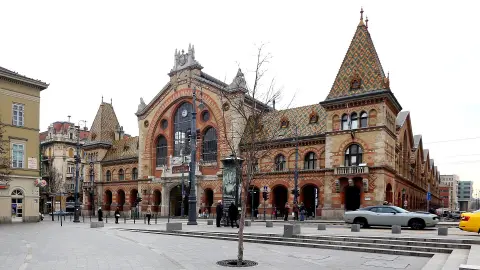
The hall stands at Fővám Square, at the southern end of Váci Street and right beside Liberty Bridge. From outside it looks almost like a church, with a high gabled front, Gothic-style arches and a patterned tiled roof. Inside, a vast central aisle runs under a glass and iron roof, with stalls on either side. The ground floor holds fresh food: fruit and vegetables, butchers, sausage makers, bakers and paprika sellers. The basement has pickles, fish and a supermarket. The gallery upstairs is lined with food counters and souvenir stalls, with views down over the whole hall.
Why it matters
The Great Market Hall is the best single introduction to Hungarian food. Here you learn the difference between sweet and hot paprika, see the famous winter salami, and taste local specialities. Locals still shop here, which keeps it honest. The building itself is a landmark of 1890s Budapest, when the city was proud, prosperous and modern. And it is a fine place to buy gifts that actually mean something: paprika, honey, Tokaji wine or a bottle of pálinka.
Your walk-through
The stops a guide would take you to, in order.
-
1
The main facade on Fővám tér
Stand back across the square and look at the front. Brick and stone, tall arches, and that shining roof in coloured Zsolnay tiles. The building opened in 1897. Notice the Liberty Bridge to your left, painted green. It opened in 1896, the same era, and together they make one of the prettiest corners of the city.
-
2
The central aisle
Walk inside and stop just past the doors. Look up at the iron roof trusses and the long rows of stalls. The light comes from above. Listen to the mix of Hungarian bargaining and tourist chatter. This is the main aisle, about the length of a football pitch, and every stall has its own personality.
-
3
The paprika stalls
Find a paprika stall, with strings of red peppers hanging like curtains. Hungarian paprika comes mainly from two regions, Szeged and Kalocsa. Ask for 'édes', which means sweet, or 'csípős', which means hot. Smell the difference. Paprika is the soul of goulash and fish soup.
-
4
The sausage and salami counters
Next, the butchers and sausage makers. Look for winter salami, wrapped in its pale mould coat, and spicy paprika sausages. You will also see goose liver, a Hungarian delicacy. The stallholders will often let you taste. Buy a little, ask them to vacuum pack it for travel.
-
5
Basement pickles
Take the stairs down to the basement. Here are barrels of pickled cabbage, cucumbers and peppers, some stuffed with cabbage in a funny little pepper face. Pickles are essential at a Hungarian table, especially with heavy meat dishes in winter.
-
6
The upstairs gallery
Finally climb to the gallery. Here you can eat. Try lángos, a crispy fried dough topped with sour cream and grated cheese. Lean on the railing with your food and look down on the whole hall. Then browse the embroidery stalls, with folk patterns from regions like Kalocsa and Matyó.
Things you might not know
- The hall opened on 15 February 1897.
- It covers roughly 10,000 square metres under a single steel structure.
- Its roof tiles were made by the Zsolnay ceramics factory of Pécs.
Researched November 2026 from: en.wikipedia.org, hungaryunlocked.com, budapestbylocals.com. Fees and hours change, so check on the day.