⭐ Must-see · The Loop, Michigan Avenue, 1 km from central Chicago
Art Institute of Chicago
Bronze lions, Impressionist light and America's most famous farmhouse
🎧 Listen to this guide · about 7 min
Pop your earphones in and we'll walk you round.
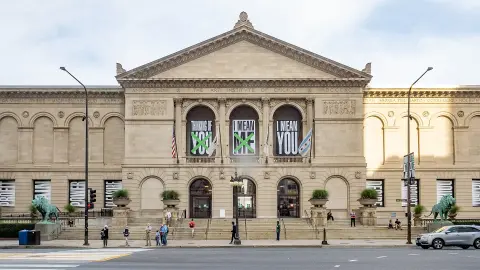
Welcome to the Art Institute of Chicago. Before you even step inside, say hello to the two bronze lions guarding the steps on Michigan Avenue. Chicagoans love them. They wear wreaths at Christmas and team helmets when the city's sports teams are winning. Behind them waits one of the great art collections of the world. Here you can walk from ancient Greek coins to Monet's haystacks, from a Chinese bronze to a Warhol, in the space of an hour. Don't try to see it all. Nobody can. Instead, let's pick a handful of rooms and give them real attention. Take your time, look closely, and let the paintings do the talking. I promise you will leave with at least one new favourite.
The story of Art Institute of Chicago
The museum began in 1879 as the Chicago Academy of Fine Arts, a school and gallery founded by local artists and patrons. In 1882 it took the name Art Institute of Chicago. At the time, the city was still rebuilding after the Great Fire of 1871, and its leaders wanted culture to match its new wealth.
The building you see on Michigan Avenue was designed by the Boston firm Shepley, Rutan and Coolidge for the World's Columbian Exposition of 1893. During the fair it hosted the World's Congress Auxiliary, then the museum moved in for good. The bronze lions by Edward Kemeys arrived in 1894. Early collectors such as Bertha Palmer filled the walls with French Impressionist paintings at a time when many critics still dismissed them, which is why Chicago's Impressionist holdings are so strong today.
The twentieth century brought gifts that defined the museum. Grant Wood's American Gothic was shown here in 1930 and bought by the museum soon after. Edward Hopper's Nighthawks was purchased in 1942, the year it was painted. In 2009 the Modern Wing, designed by Renzo Piano, opened on the north side, adding light-filled galleries for twentieth-century art and a footbridge to Millennium Park.
The setting
The museum sits on the eastern edge of the Loop, in Grant Park, with Michigan Avenue at its front door and railway tracks running in a cut beneath its later wings. The original 1893 building is Beaux-Arts in style, with a grand staircase rising from the entrance hall to the European painting galleries on the second floor. Over the decades the museum spread east across the tracks, so today you move through a chain of connected buildings. The Modern Wing, on Monroe Street, is the lightest of them all, with a floating roof that filters daylight into the galleries. A long white footbridge, the Nichols Bridgeway, leaps from its third floor across Monroe Street into Millennium Park. Inside, galleries are numbered, and free maps help you find your way.
Why it matters
The Art Institute is one of the most visited art museums in the country and a major art school as well; the School of the Art Institute still trains artists today. Its collection holds paintings that have become part of how Americans picture themselves, from the stern farmer in American Gothic to the lonely diner in Nighthawks. For Chicago, it is a point of pride, proof that a city famous for railroads and stockyards also built a home for beauty. For you, it is a chance to meet famous works face to face, at their real size and in their real colours.
Your walk-through
The stops a guide would take you to, in order.
-
1
The bronze lions on Michigan Avenue
Start outside. These two lions were made by the sculptor Edward Kemeys and set in place in 1894. One is said to stand in an attitude of defiance, the other on the prowl. Chicago dresses them for big moments, with wreaths in December and helmets in winning seasons. Take your photo here, then look up at the building behind them, built for the World's Columbian Exposition. You are about to walk through the same doors visitors used in 1893.
-
2
The Grand Staircase
Inside, climb the broad staircase straight ahead. It leads up to the European painting galleries, the heart of the old museum. Pause halfway and look back down at the entrance hall. This is the core of the 1893 building, and you can feel its ambition in the high ceilings and the wide, slow steps. At the top, follow the signs for Impressionism. The rooms ahead hold some of the best French paintings outside France.
-
3
Seurat and the Impressionist galleries
Here is A Sunday on La Grande Jatte by Georges Seurat, painted in the mid-1880s. Step close and the scene breaks into thousands of tiny dots of colour. Step back and it melts into a calm afternoon by the Seine. Nearby you will usually find Gustave Caillebotte's Paris Street; Rainy Day and several of Monet's paintings of stacks of wheat, each showing the same subject in different light. Watch how the colours change as you move.
-
4
American Gothic and Nighthawks
Now head to the American art galleries. Grant Wood painted American Gothic in 1930, using his sister and his dentist as models for the farmer and the woman beside him. Notice how the pitchfork's shape repeats in the stitching of his overalls and the window above. Not far away hangs Edward Hopper's Nighthawks, from 1942. Three customers and a server sit in a glowing diner on an empty street. There is no door you can see. Let that quiet sink in.
-
5
The Thorne Miniature Rooms
Go down to the lower level for something delightful. These are the Thorne Miniature Rooms, sixty-eight tiny rooms built in the 1930s and 1940s under the direction of Narcissa Niblack Thorne. Each one shows a home interior from Europe or America, scaled at one inch to one foot. Look for the working details: little books, carpets, candlesticks, even views through the windows. Children love them, and so do most grown-ups, if they are honest.
-
6
The Modern Wing and Nichols Bridgeway
Finish in the Modern Wing, Renzo Piano's addition from 2009. The light here is soft and even, filtered through a roof of fine blades. On the upper floors you will find modern and contemporary art, from Picasso to Warhol, depending on what is on view. Then walk out onto the Nichols Bridgeway. It carries you over Monroe Street and straight into Millennium Park, with the city skyline right in front of you.
Things you might not know
- The bronze lions out front have stood on Michigan Avenue since 1894.
- Grant Wood's models for American Gothic were his sister Nan and his dentist.
- The Thorne Miniature Rooms are built at a scale of one inch to one foot.
Researched November 2026 from: artic.edu, en.wikipedia.org, choosechicago.com. Fees and hours change, so check on the day.