🚗 Day trip · Northwest Indiana, Lake Michigan shore, 65 km from central Chicago
Indiana Dunes National Park
Sand, wind and an inland sea, an hour from downtown
🎧 Listen to this guide · about 6 min
Pop your earphones in and we'll walk you round.
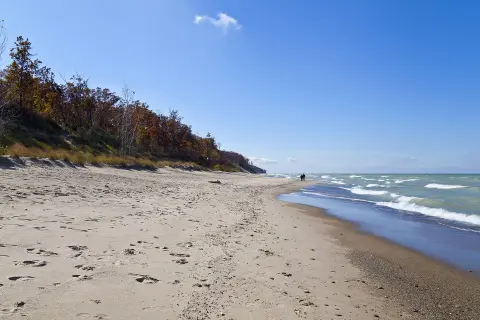
Welcome to Indiana Dunes National Park. Take off your shoes if the weather allows, and feel the sand. In front of you, Lake Michigan stretches to the horizon like a freshwater sea. Behind you, dunes rise in soft waves, covered in grasses, then pines and oaks. On a clear day you can even see the towers of Chicago far across the water. It is hard to believe a big city is so close. This shoreline is where the science of ecology took its first steps in America, and where ordinary people fought to save the land. Let's walk from the beach up into the dunes, and I'll show you how sand becomes forest.
The story of Indiana Dunes National Park
When the glaciers of the last Ice Age melted, they left behind a huge lake, and over thousands of years the wind and waves piled sand along its southern shore. Native peoples, including the Potawatomi, hunted and gathered here for generations. In 1822 the fur trader Joseph Bailly set up a trading post on the Little Calumet River, now preserved as the Bailly Homestead.
In the 1890s Henry Chandler Cowles, a botanist from the University of Chicago, came to study the dunes. He noticed that plants changed in a clear order as you walked from the beach inland, from grasses to shrubs to forests. His 1899 work on this plant succession helped found the science of ecology in America. At the same time, industry was spreading along the shore, with steel mills rising in Gary from 1906.
A long fight to protect the dunes followed. Indiana Dunes State Park was created in the 1920s. Later, Dorothy Buell and the Save the Dunes Council campaigned for national protection, and Illinois Senator Paul H. Douglas led the effort in Congress. In 1966 the Indiana Dunes National Lakeshore was authorised. On February 15, 2019, it became Indiana Dunes National Park, the first national park in Indiana.
The setting
The park covers about 15,000 acres along roughly 15 miles of Lake Michigan's southern shore, between Gary and Michigan City. It is not one block of land but a string of separate pieces, broken by towns, steel mills and the separate Indiana Dunes State Park in the middle. Habitats change quickly: open beaches, tall dunes, quiet wetlands, black oak savanna, prairie and shady forest. This mix makes it one of the most varied national parks for plants, with more than 1,400 native plant species. Trails range from flat boardwalks to steep dune climbs. In winter, the beaches can be lined with shelf ice.
Why it matters
Indiana Dunes matters as a birthplace of American ecology, where scientists first described how plant communities change over time. It also shows how citizens can protect wild places even beside heavy industry. For people in Chicago and northwest Indiana, it is the nearest real wilderness, a place to swim, hike and watch migrating birds. Its variety of plants rivals parks many times larger. For visitors, it offers a surprising side of the Midwest: soft sand, big skies and the sound of waves, a short train ride from downtown.
Your walk-through
The stops a guide would take you to, in order.
-
1
Paul H. Douglas Center and Miller Woods
Start at the western end, at the Paul H. Douglas Center in the Miller neighbourhood of Gary. Here, trails lead through black oak savanna and past ponds between ancient dune ridges to the beach. It is named after the senator who fought for the park. The centre is a good place to learn about the dunes before you explore. Look for prickly pear cactus growing wild in the sand.
-
2
West Beach
Drive or walk on to West Beach. Here the shore is wide and open, and on a clear day you can see the Chicago skyline far to the northwest. In summer this is a favourite swimming beach, with lifeguards in season. In winter, it is wild and empty, with ice piling along the waterline. Stand by the water and listen; the waves here can be surprisingly strong.
-
3
West Beach Succession Trail
Now take the Succession Trail behind West Beach. This is where Henry Cowles's ideas come alive. You climb from bare sand with marram grass, past cottonwoods and shrubs, into jack pines and finally oak forest. Long stairways and boardwalks help you up the steepest dunes. Stop at the top and look back at the lake. You have just walked through thousands of years of change in less than an hour.
-
4
Indiana Dunes Visitor Center
Head east to the Indiana Dunes Visitor Center near Porter. Here you can get maps, ask rangers about trail and beach conditions, and see exhibits about the park's plants, animals and history. It is a good stop if you are visiting in winter, when some facilities are closed. Ask about ranger-led walks; they can show you things you would easily miss alone.
-
5
Century of Progress Homes
Drive along Lake Front Drive in Beverly Shores to see the Century of Progress Homes. These five houses were built for the 1933 Chicago World's Fair as homes of the future, and were later moved here, some of them across Lake Michigan by barge. One is made almost entirely of glass, another is painted pink. They are privately leased, so admire them from the road, but they are a delightful slice of history.
-
6
Mount Baldy
End at Mount Baldy, near Michigan City. This is a living dune, about 123 feet high, that has been moving inland, pushed by the wind. To protect it, the summit has been closed to free climbing since 2018, though a trail leads around it to the beach, and rangers sometimes lead guided hikes. Watch the sand blow across the crest, and feel how alive this landscape is.
Things you might not know
- Botanist Henry Cowles's 1899 study of these dunes helped found American ecology.
- The park has more than 1,400 native plant species, among the most of any US national park.
- Mount Baldy is a moving dune that has crept inland several feet a year.
Researched November 2026 from: nps.gov, nps.gov, en.wikipedia.org. Fees and hours change, so check on the day.