💎 Hidden gem · Jackson Park, Hyde Park, 14 km from central Chicago
Garden of the Phoenix (Osaka Garden)
A Japanese garden on a World's Fair island
🎧 Listen to this guide · about 6 min
Pop your earphones in and we'll walk you round.
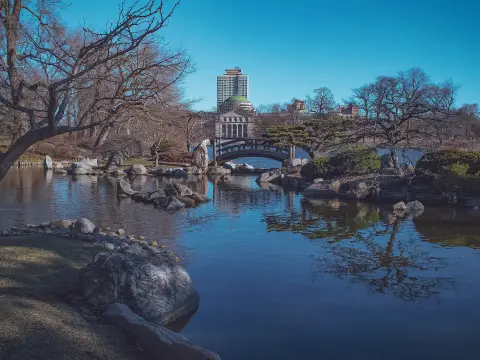
Welcome to the Garden of the Phoenix, also called the Osaka Garden. We are on Wooded Island, in Jackson Park, far from the downtown crowds. Listen. Instead of traffic, you hear birds, the splash of a small waterfall and the wind in the trees. A curved red-trimmed gate leads you in, a stone lantern stands by the pond, and in spring cherry blossoms cloud the paths. This little garden has a long memory. It stands where Japan built its pavilion for the great World's Fair of 1893, the first time many Americans saw Japanese architecture with their own eyes. Walk slowly here. Japanese gardens are made for pausing, not rushing.
The story of Garden of the Phoenix (Osaka Garden)
In 1893 Chicago hosted the World's Columbian Exposition, and Jackson Park became a dreamlike city of white palaces and lagoons designed by Frederick Law Olmsted and Daniel Burnham. Wooded Island was meant to be a quiet natural refuge in the middle of it all. At its north end, the Japanese government built the Ho-o-den, or Phoenix Pavilion, dedicated on March 31, 1893. Its design was based on the Phoenix Hall of the Byodo-in temple at Uji, near Kyoto. Many Chicagoans saw a fitting symbol in the phoenix, for a city that had risen from the fire of 1871. The pavilion is often said to have influenced the young Frank Lloyd Wright.
After the fair, most of its buildings were demolished or burned, but the Phoenix Pavilion survived and was given to the city. For the Century of Progress fair in 1933 and 1934, Japan added a tea house and created a garden on the island and refurbished the pavilion. During and after the Second World War the site was neglected, and in 1946 fire destroyed the buildings.
The garden survived in fragments. In the 1990s, through Chicago's sister-city friendship with Osaka and the Chicago Park District, it was restored and named the Osaka Garden in 1993. Since then, cherry trees have been planted, and in 2016 Yoko Ono's sculpture Skylanding was installed nearby on the old pavilion site.
The setting
Wooded Island lies in the middle of the lagoons of Jackson Park, on Chicago's South Side, just east of the University of Chicago and south of the Museum of Science and Industry. You cross a bridge to reach it. The garden occupies the island's northern end and is laid out as a stroll garden around a pond, with a waterfall, stepping stones, a moon bridge arching over the water, stone lanterns and carefully shaped pines. Paths wind so that every few steps the view changes. Beyond the garden, the rest of the island is a wilder bird sanctuary, with native plantings and lagoons where herons and ducks gather.
Why it matters
This garden is one of the oldest living links between Chicago and Japan, and between today's city and the World's Fair of 1893, when Chicago introduced itself to the world. It tells a story of friendship that survived war and loss. For birdwatchers, Wooded Island is one of the best spots in the city during spring and autumn migration. For visitors, it offers something rare in a big city: true quiet, a place to think, and an unexpected side of the South Side that many tourists never see.
Your walk-through
The stops a guide would take you to, in order.
-
1
The bridge to Wooded Island
Start on the bridge from the mainland. Look out over the lagoons. In 1893 these waters were busy with gondolas and electric launches carrying fairgoers between palaces. Today they are home to ducks, herons and turtles. Behind you, to the north, is the Museum of Science and Industry, which occupies the fair's old Palace of Fine Arts, one of the few buildings that survived.
-
2
The garden gate
Now walk to the garden's entrance gate. Japanese gardens often begin with a gate to mark a change, from the everyday world into a calmer one. Pause before you pass through. Take a breath and leave your hurry outside. Inside, the paths are narrow and winding on purpose, so you notice the details: the moss, the stones, the shapes of the trees.
-
3
The pond and moon bridge
Follow the path to the pond. The arched moon bridge rises over the water. On a calm day its reflection completes the curve into a full circle, which is where the name comes from. Look at the stone lanterns by the edge, a classic feature of Japanese gardens. Watch for koi and turtles below the surface, and for the way the gardeners have shaped the pines to lean gracefully over the water.
-
4
The waterfall
Continue to the small waterfall. In Japanese garden design, falling water stands for the mountains and rivers of nature, brought into a small space. Listen to it for a moment. The sound changes as you move along the path, sometimes loud, sometimes hidden. Garden designers think carefully about sound as well as sight, and this is a lovely place to notice that.
-
5
Skylanding
Just beside the garden, on the site where the Phoenix Pavilion once stood, you will find Skylanding, a sculpture by the artist Yoko Ono installed in 2016. It looks like a ring of giant steel lotus petals. Ono, who was born in Tokyo, said she imagined it as a place of peace. Stand in the middle and look up at the sky through the petals.
-
6
The cherry trees and Wooded Island trails
Finish by wandering among the cherry trees planted on the island since 2012 and 2013. In late April or early May, if you are lucky with timing, they burst into soft pink bloom. Then, if you have time, follow the trails south into the wilder part of Wooded Island, a bird sanctuary where you may hear warblers in spring. It is a gentle way to end.
Things you might not know
- Japan's Phoenix Pavilion stood here from 1893 until fire destroyed it in 1946.
- The pavilion's design was based on the Phoenix Hall of the Byodo-in temple near Kyoto.
- The garden was restored and named the Osaka Garden in 1993, honouring Chicago's sister city.
Researched November 2026 from: en.wikipedia.org, chicagoparkdistrict.com, en.wikipedia.org. Fees and hours change, so check on the day.