💎 Hidden gem · Nørrebro, 2 km from central Copenhagen
Assistens Cemetery
Tall trees, quiet paths and the graves of great Danes
🎧 Listen to this guide · about 5 min
Pop your earphones in and we'll walk you round.
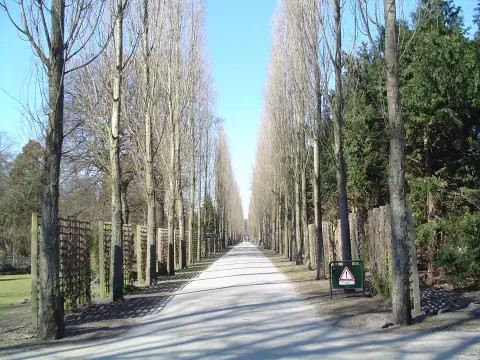
Welcome to Assistens Cemetery, in the heart of Nørrebro. Step through the gate and the traffic fades. Long avenues of tall trees, ivy-covered walls and old headstones stretch away in every direction. It may surprise you, but locals use much of this place as a park. You will see people walking, reading on benches and cycling slowly along the paths. Among the graves lie some of the most famous Danes who ever lived: the storyteller Hans Christian Andersen, the philosopher Søren Kierkegaard and the physicist Niels Bohr. It is still an active cemetery, so we walk gently and speak softly. Let's follow the paths together and find their resting places.
The story of Assistens Cemetery
Assistens Cemetery was founded in 1760, outside what was then the Northern City Gate. The name means assisting, because it was created to help the crowded churchyards inside the city walls. Those churchyards had been under severe pressure for decades. A plague in 1711 killed an estimated 23,000 people in Copenhagen, and space for burials had run out. At first the new cemetery was used mainly for the poor.
That changed toward the end of the 18th century. It became fashionable for wealthy and well-known families to be buried here, among the trees and away from the city. Through the 19th century the cemetery filled with the graves of artists, writers and scientists. Søren Kierkegaard was buried in his family plot in 1855. Hans Christian Andersen was buried here in 1875, and the physicist Niels Bohr in 1962.
Over time the city grew around it, and Nørrebro became a dense working-class district. The cemetery became its largest green space. Today much of the grounds are run as a park, while burials still take place in the reserved areas.
The setting
The cemetery covers about 25 hectares, a large walled area in the middle of Nørrebro. It is laid out in sections, labelled with letters, crossed by straight avenues of old trees such as lime and poplar. Some sections feel formal, with neat hedges and grand family plots. Others feel wild, with ivy, moss and leaning stones. The yellow walls of the cemetery separate it from the busy streets outside. Near one corner, an old stable building holds a small museum and café.
Why it matters
Assistens matters because it holds the memory of Denmark's golden age in one place. Writers, painters and scientists who shaped Danish culture lie here. It also matters to everyday life in Nørrebro, where it is the main green space for thousands of people. The way locals share this place, mixing respect for the dead with daily life, says a lot about Copenhagen's relaxed character. Please remember it is still a working cemetery.
Your walk-through
The stops a guide would take you to, in order.
-
1
The main gate on Kapelvej
We enter from Kapelvej. Look for the map board near the gate; it marks the sections and the graves of well-known people. Notice the yellow walls and the long avenues of trees ahead. This place was outside the city when it opened in 1760. The city grew up around it, and now it sits right in the middle of Nørrebro.
-
2
Søren Kierkegaard's family grave
Now we come to Section A, the oldest part. Here lies Søren Kierkegaard, the philosopher, buried in 1855 in his family's plot, alongside his parents and siblings. Kierkegaard wrote about faith, choice and the individual, and he is often called the father of existentialism. His grave is simple. Pause here for a moment. People from all over the world come to pay their respects.
-
3
Hans Christian Andersen's grave
Next we find the grave of Hans Christian Andersen, who died in 1875. He wrote The Little Mermaid, The Ugly Duckling and many more tales loved around the world. You will often see small flowers or notes left here by visitors. Andersen was born poor in Odense and came to Copenhagen with almost nothing, so it is fitting he rests in a place that began as a cemetery for ordinary people.
-
4
Niels Bohr's grave
Further along lies Niels Bohr, the physicist who won the Nobel Prize in 1922 for his work on the structure of the atom. He was buried here in 1962 in his family plot. Look around and notice how many family graves there are. Generations of Copenhagen families lie together in these sections.
-
5
The jazz graves
Now look for the graves of two American jazz musicians, the saxophonist Ben Webster and the pianist Kenny Drew. Both made Copenhagen their home in later life, when the city had a lively jazz scene. They are a reminder of how open the city was to artists from abroad.
-
6
The tree avenues
We finish in one of the long tree-lined avenues. Walk slowly and take in the quiet. You may see people sitting with a coffee, students reading, or a child learning to ride a bike. Here the living and the dead share a space respectfully. It is one of the most peaceful places in Copenhagen.
Things you might not know
- The cemetery was founded in 1760 to relieve crowded churchyards inside the city walls.
- It covers about 25 hectares and is the largest green space in inner Nørrebro.
- Two American jazz musicians, Ben Webster and Kenny Drew, are buried here.
Researched November 2026 from: en.wikipedia.org, kk.dk, visitcopenhagen.com. Fees and hours change, so check on the day.