💎 Hidden gem · Nørrebro, 3 km from central Copenhagen
Superkilen
A red square, a black market and objects from the world
🎧 Listen to this guide · about 5 min
Pop your earphones in and we'll walk you round.
Welcome to Superkilen, in the heart of Nørrebro, Copenhagen's most international neighbourhood. Look down. The ground is painted in bold red, pink and orange. Look around, and you will see a Moroccan fountain, swings from Iraq, a Soviet bus stop, palm trees from China and neon signs from around the world. This park is a kind of world map you can walk through. It was designed with the people who live here, many of whom have roots in other countries. They helped choose objects that remind them of home. Bring your curiosity. Today we'll walk the full length, from the red square to the green hills, and see what you can find.
The story of Superkilen
Nørrebro has long been one of the most diverse districts of Copenhagen. Residents here come from dozens of different countries. In the 2000s the city decided to turn a long, narrow strip of land, a wedge between busy streets and a railway line, into a new park. The name Superkilen means something like the super wedge.
The design was a collaboration between three teams: the architects BIG, the landscape architects Topotek 1 from Berlin and the Danish artist group Superflex. Their idea was simple and bold. Instead of choosing standard city furniture, they asked local residents to suggest objects from the countries they came from. Some objects were bought, some were copied, and some were brought here from abroad.
The park opened in June 2012. It quickly drew attention from designers around the world. In 2016 it won the Aga Khan Award for Architecture, and it had already won a 2013 Honor Award from the American Institute of Architects. Most importantly, it became a daily meeting place for people in the neighbourhood.
The setting
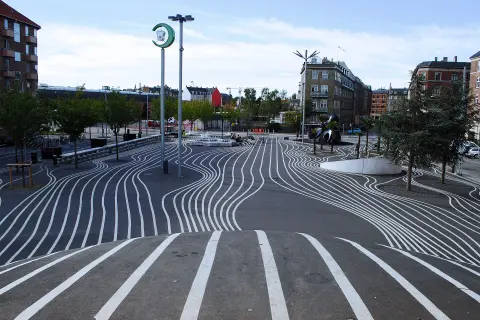
Superkilen runs for close to a kilometre through Nørrebro, with a cycle path running along it. It is divided into three zones. The Red Square, with its red, pink and orange surface, is for sport and activity. The Black Market, in the middle, has a black surface painted with curving white lines, and is a place to sit, play board games and meet. The Green Park, at the northern end, has grassy hills, trees and space for picnics. Throughout, you find more than a hundred objects from around fifty to sixty countries.
Why it matters
Superkilen matters because it shows how a city can design public space together with the people who use it. It gives residents with roots across the world a visible place in their neighbourhood. It has become a model for urban designers internationally. And it is simply a lively, cheerful place, where you can watch everyday Copenhagen life unfold, from children on swings to old men playing chess.
Your walk-through
The stops a guide would take you to, in order.
-
1
The Red Square
We begin in the Red Square near Nørrebrogade. Look at the bright red, pink and orange ground, which spreads up onto the walls of the buildings around it. This zone is for activity: you will often see people playing sport or skateboarding. Look for neon signs mounted on poles; they come from shops and hotels in many different countries.
-
2
The Moroccan fountain
Next, look for the tiled fountain. It is modelled on a Moroccan design, with patterned tiles and a basin. It is one of the objects chosen to reflect the backgrounds of the people who live here. Notice how ordinary it feels. That is the point: in Nørrebro, Moroccan and Danish life sit side by side every day.
-
3
The Black Market
Now we enter the Black Market. The black ground is painted with curving white lines that flow around benches and trees. This is the neighbourhood's outdoor living room. Look for the chess tables, and keep an eye out across the park for the Japanese octopus slide that children love. On a warm day, this is where the neighbourhood comes to sit and talk.
-
4
The Soviet bus stop and swings
Look around the middle section for a curved concrete bus shelter, modelled on one from the former Soviet Union, and the swings that come from Iraq. Each object has a small plaque explaining where it is from. Take a few minutes to read them. It is a little like a treasure hunt across the world.
-
5
The Green Park
Finally, we reach the Green Park at the northern end. Here the colour shifts to soft grass and small hills. It is a calmer space for picnics, play and sunbathing in summer. Climb one of the hills and look back along the length of Superkilen. From up here you can see how the three zones fit together, from red, to black, to green.
Things you might not know
- Superkilen opened in June 2012.
- It won the Aga Khan Award for Architecture in 2016.
- Residents helped choose many of its objects, which come from dozens of countries.
Researched November 2026 from: en.wikipedia.org, big.dk, dac.dk, dezeen.com. Fees and hours change, so check on the day.