⭐ Must-see · Indre By, 2 km from central Copenhagen
Nyhavn
Painted gables, tall masts and the old sailors' harbour
🎧 Listen to this guide · about 6 min
Pop your earphones in and we'll walk you round.
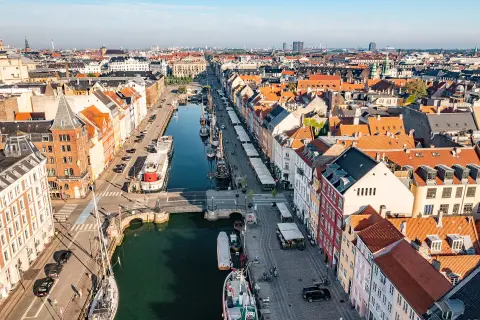
Welcome to Nyhavn, the New Harbour. Stand here for a moment and let your eyes adjust to the colour. Ochre, brick red, mustard yellow and sky blue houses lean shoulder to shoulder along the water. Below them, old wooden ships rock gently at their moorings, their masts drawing thin lines against the sky. On a summer evening the quay fills with people sitting on the stone edge, feet dangling over the canal. In winter the light comes low and golden, and the cafés glow behind fogged windows. This was once a rough sailors' quarter of taverns and lodging houses. Today it is the city's favourite place to sit, look and linger. Let's walk the quay together, from the great anchor to the water's edge, and I'll show you who lived behind these painted walls.
The story of Nyhavn
Nyhavn was dug in the early 1670s on the orders of King Christian V. The work was done by Danish soldiers and by Swedish prisoners taken in the war of 1658 to 1660. The idea was simple. Ships could sail straight in from the harbour and unload their cargo right in the heart of the city, at the great new square of Kongens Nytorv.
For more than two centuries this was a working port. Merchants built handsome houses on the quieter north side, while the south side filled with taverns, tattoo parlours and rooms for sailors between voyages. The oldest house still standing, number 9, dates from 1681. Hans Christian Andersen lived on the canal at different times in his life, including at number 67 from 1845 to 1864, and at number 18 from 1871 to 1875.
As ships grew larger in the 20th century, trade moved away and the quay grew shabby. In 1977 Nyhavn was reborn as a harbour for veteran ships, and in 1980 the quay was closed to cars. Restaurants and cafés moved in, and the sailors' quarter slowly became the place locals bring their visitors first.
The setting
The canal runs east from Kongens Nytorv down to the main harbour, a straight stretch of water a few hundred metres long. The north side, the sunny side, is the famous one, with its row of gabled townhouses painted in warm colours and its line of café tables. The south side is calmer, with grander houses and more room to walk. At the harbour end a pedestrian bridge, Inderhavnsbroen, crosses toward Christianshavn and the Opera House area. Along the quay you will see historic wooden ships, many with their rigging still in place. Canal tour boats leave from here, gliding under low bridges and out into the wider harbour.
Why it matters
Nyhavn matters because it shows how a city can keep its old bones and give them a new life. The canal no longer carries cargo, but the historic ships moored here are part of a living museum harbour. The quay is now one of the main gathering places in Copenhagen, for locals as much as for visitors. Its painted façades have become a symbol of the city around the world. And its memorial anchor keeps alive the memory of the sailors who died in the Second World War.
Your walk-through
The stops a guide would take you to, in order.
-
1
The Memorial Anchor
We begin at the head of the canal, by the great iron anchor. It is a memorial to more than 1,700 Danish sailors and Allied personnel who lost their lives in the Second World War. The anchor itself came from the frigate Fyn and dates from 1872. It was placed here in 1951, replacing a wooden cross set up in 1945. Every year on the 5th of May, the date Denmark marks its liberation, a ceremony is held right here.
-
2
Number 9, the oldest house
Walk a little way along the sunny north side and look for number 9. This house dates from 1681, which makes it the oldest building on the canal. Notice how low the ground floor is and how simple the lines are, compared with some of its taller neighbours. The houses here once held merchants, ship owners and lodgers. Picture barrels and crates being hauled straight from ships up into these lofts.
-
3
Number 18, Andersen's later home
Here at number 18, Hans Christian Andersen lived from 1871 to 1875, in the last years of his life. He was by then famous across Europe for his fairy tales. Look up at the windows and imagine the old writer looking down on the masts below. Today the ground floor sells Andersen souvenirs, so the storyteller still draws a crowd.
-
4
The veteran ships
Turn now to the water. Many of these wooden vessels are historic ships, kept in sailing condition by their owners and moored here as part of the veteran ship harbour created in 1977. Look at the rigging, the polished wood and the hand-painted names on the bows. Each one has its own working history, from cargo runs along the coast to fishing in the North Sea.
-
5
Number 67, the plaque
Cross to the quieter south side and walk toward the harbour until you reach number 67. A plaque marks the house where Andersen lived from 1845 to 1864, nearly twenty years. This was a productive time in his writing life. The south side was always the calmer side of the canal, and you will feel that difference as the café noise fades behind you.
-
6
The harbour mouth and bridge
We finish where the canal meets the main harbour. Ahead of you, the slim bridge Inderhavnsbroen carries walkers and cyclists across to Christianshavn. To your left, along the water, you can see toward the Royal Danish Playhouse. This is a good place to turn and look back up the canal, with the whole row of painted houses lined up in front of you. If you want to see the city from the water, the tour boats leave from just behind you.
Things you might not know
- The canal was dug in the early 1670s partly by Swedish prisoners of war.
- The memorial anchor came from the frigate Fyn and dates from 1872.
- Hans Christian Andersen lived in at least two different houses on Nyhavn, numbers 67 and 18.
Researched November 2026 from: en.wikipedia.org, visitcopenhagen.com. Fees and hours change, so check on the day.