⭐ Must-see · George Town heritage core, 1 km from central Penang
Armenian Street and the George Town Murals
Painted walls, old shophouses and a revolution plotted upstairs
🎧 Listen to this guide · about 7 min
Pop your earphones in and we'll walk you round.
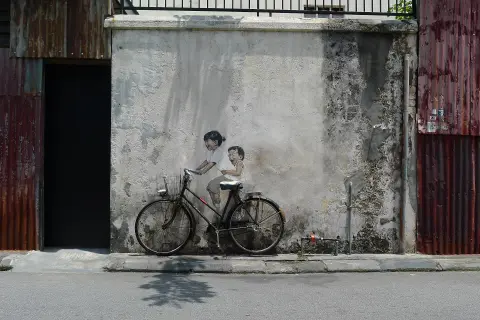
Welcome to Armenian Street. Look down the lane and you will see why people fall for George Town. Low shophouses with wooden shutters. Faded pastel walls. Bicycles leaning in doorways. And then, painted right onto the plaster, two children riding a real old bicycle that seems to roll out of the wall. This is the most photographed corner of Penang's street art, and it sits inside the UNESCO World Heritage zone. But the murals are only the newest layer. This street has seen Armenian traders, Chinese clan wars and a Chinese revolutionary raising money for a new republic. So keep your camera ready, but keep your eyes open too. The best stories here are not always painted on the walls.
The story of Armenian Street and the George Town Murals
The street began life as Malay Lane, named after a nearby Malay settlement. By 1808 it had become Armenian Street, after the Armenian traders who lived and worked here. They built St Gregory's Church in 1822, but most of the community had drifted away by the time the church was pulled down in 1937.
From the mid-nineteenth century the street became mostly Chinese. Clan associations built their halls nearby, including the great Khoo Kongsi just around the corner. It was also a place of secret societies. In 1867 rival societies fought a turf war across George Town, known as the Penang Riots, and some of the heaviest fighting took place right here. In 1910 the street played a part in a much bigger story. Sun Yat-sen chaired a meeting in a townhouse on this street, the Penang Conference, and raised money for the uprising against the Qing dynasty. That house is now the Sun Yat-sen Museum.
The art arrived in 2012. For the George Town Festival that year, the Lithuanian-born artist Ernest Zacharevic painted a series of six murals around the old town, using local people as models. Children on a Bicycle, here on Armenian Street, became a symbol of the city almost overnight. A couple of years earlier, the state had also commissioned witty wrought-iron caricatures, fixed to walls across the heritage zone, that explain each street's history in cartoon form.
The setting
Armenian Street runs for a short distance through the southern part of the heritage core, close to the waterfront and the clan jetties. It is lined with two-storey shophouses with a covered five-foot way at street level, so you can walk in the shade. Many now hold small cafes, galleries and craft shops. The lanes around it are a grid of narrow streets, among them Cannon Street, Ah Quee Street and Beach Street. The murals are scattered through this grid rather than in one place, so the area is best explored on foot, with a map or a little curiosity. Look for the iron caricatures at corners, and for murals that use real objects like bicycles, chairs and windows as part of the picture.
Why it matters
The murals changed how the world sees Penang. They brought a new generation of visitors into old streets that had been quietly emptying, and helped many shophouses find new life as homes, studios and cafes. At the same time, the street holds older meanings. The Sun Yat-sen Museum recalls Penang's link to the 1911 revolution in China, and the clan houses still serve their families. Walking here, you see a living heritage town, where people still sell, pray, cook and paint. That mix is exactly what UNESCO recognised in 2008.
Your walk-through
The stops a guide would take you to, in order.
-
1
Children on a Bicycle
Start at the mural everyone comes for. A girl pedals, her little brother clings on behind, and the bicycle is real, bolted to the wall. Zacharevic painted it for the 2012 George Town Festival, using local children as his models. Come early and you might have it to yourself. Later in the day, people queue politely for photos. Notice how the paint has softened in the tropical sun. Locals have chosen to keep it, faded edges and all.
-
2
Sun Yat-sen Museum
A few steps along is an ordinary looking shophouse with an extraordinary past. In 1910 Sun Yat-sen chaired a meeting here with his supporters, now remembered as the Penang Conference. Money raised in Penang helped fund the uprising against the Qing dynasty in China. Inside, the house is kept as a traditional Straits Chinese home, with an airwell open to the sky. Look up at the light falling into the centre of the house.
-
3
The iron caricatures
Keep an eye on the walls at street corners. You will find drawings made of black wrought iron, like a cartoon sketched in metal. Each one tells a small story about the street it hangs on, a trade, a nickname, a bit of local humour. They were installed around 2010, before the painted murals, as a way to explain the heritage zone. Read a few as you walk. They are short, funny and surprisingly informative.
-
4
Yap Kongsi
Along this stretch stands the clan temple of the Yap family, one of the many clan associations of George Town. Clan houses were the social safety net for Chinese migrants. They helped newcomers find work, settled disputes and cared for the dead. Look at the roof ridges and the carved details at the entrance. Then compare it with the grander Khoo Kongsi nearby. Each clan wanted its hall to say something about its standing.
-
5
Ah Quee Street murals
Wander east toward Ah Quee Street. Here you will find another of the 2012 murals, a boy perched on a real old motorcycle, painted onto a shophouse wall. Like the bicycle mural, it mixes paint with a solid object, so you can step into the scene. The street is named after a Chinese leader of the nineteenth century. Take your time here. Side walls and back lanes often hide smaller, newer pieces by other artists.
-
6
Cannon Street and the lanes
Finish by drifting through the lanes back toward Cannon Street. This is the beauty of the heritage zone. There is no fixed route, and every corner shows you something. Old trades still survive here, from joss stick makers to tinsmiths. Smell the incense, hear the scooters, peek into a shop where someone is mending something by hand. The murals brought people here, but this daily life is what makes them stay.
Things you might not know
- The street was called Malay Lane before it was renamed Armenian Street by 1808.
- Sun Yat-sen held the 1910 Penang Conference in a townhouse on this street.
- Ernest Zacharevic painted six murals for the 2012 George Town Festival.
Researched November 2026 from: en.wikipedia.org, en.wikipedia.org, whc.unesco.org. Fees and hours change, so check on the day.