⭐ Must-see · Leith Street, George Town, 1 km from central Penang
Cheong Fatt Tze Mansion (The Blue Mansion)
A merchant's indigo palace, rescued and reborn
🎧 Listen to this guide · about 5 min
Pop your earphones in and we'll walk you round.
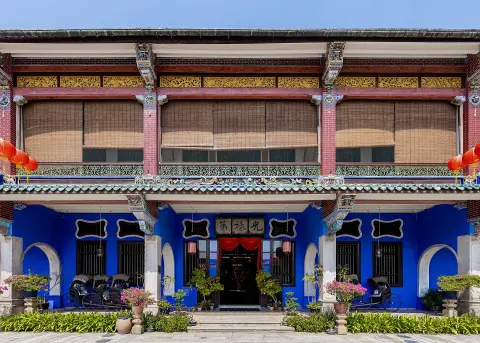
You cannot miss it. On Leith Street stands a mansion painted a deep, bold blue, almost glowing in the sun. This is the Cheong Fatt Tze Mansion, better known as the Blue Mansion. It was built over a century ago for one of the richest Chinese merchants in Asia, and it almost disappeared. Today it has been brought back to life, room by room, as a museum and a boutique hotel. On the guided tour you will step through its courtyards, under its carved timber screens, and into the story of the man who built it. Keep your eyes on the details. Almost nothing here was left to chance.
The story of Cheong Fatt Tze Mansion (The Blue Mansion)
Cheong Fatt Tze was a Hakka from Guangdong in southern China. He left home as a young man and built a business empire across Southeast Asia, in trading, plantations, shipping and more. He also served as a Qing consul and founded the Changyu winery in China in 1892. In Penang he wanted a home that showed his success and followed the rules of feng shui.
Construction began in 1897 and was completed in 1904. The house followed southern Chinese courtyard design, but mixed in Western touches, from cast-iron work to Art Nouveau glass. Cheong died in 1916, and over the decades the house was divided among descendants and tenants and slowly fell into decay.
In 1989 a group of Penang residents bought the property to save it from development and possible demolition. They restored it with great care, using traditional materials and methods, and the work was completed in the mid-1990s. The mansion won Malaysia's national architecture award for conservation in 1995, and in 2000 it received UNESCO's Most Excellent award for heritage conservation in the Asia-Pacific. It has also appeared in films, including the Oscar-winning Indochine and Crazy Rich Asians.
The setting
The mansion stands on Leith Street at the northern edge of the heritage zone. It has two floors, 38 rooms, five granite-paved courtyards, seven staircases and 220 timber louvred windows. The famous blue comes from lime mixed with natural indigo, a colour chosen for prestige and for its cooling effect. Inside, the rooms are arranged around open courtyards that bring in air and light. Look for carved and gilded timber screens, cut porcelain on the roof ridges, Scottish cast iron and stained glass. Today part of the house is a hotel, so tours keep to the public areas.
Why it matters
The Blue Mansion is one of the great examples of heritage rescue in Asia. Its restoration showed that old buildings in George Town could be saved rather than replaced, and it helped build the case for the city's UNESCO listing in 2008. It also tells the story of the Chinese diaspora, of migrants who crossed the sea with nothing and built empires. The house was designed with feng shui principles in mind, and the tour explains how they shaped every space.
Your walk-through
The stops a guide would take you to, in order.
-
1
The blue facade
Start outside, on Leith Street. Look at that blue. It was made by mixing lime with natural indigo dye. Blue was a costly and prestigious colour, and the lime helped keep the walls cool. Notice the symmetry of the front, the carved timber over the entrance and the stone details. It is a statement of wealth, made in paint and plaster.
-
2
Main courtyard
Step inside to the central courtyard. Feel the air move. The open courtyard pulls in light and breeze, and rain falls straight into it, collected below. In feng shui, water flowing into the house brings wealth, and it is said this courtyard was designed with that in mind. Look up at the galleries on the upper floor and the lacy cast iron.
-
3
Carved timber screens
Look at the timber screens between the rooms. They are carved and gilded with birds, flowers and scenes from Chinese stories. Screens like these let air pass, but give privacy. Your guide will point out symbols of luck, long life and prosperity hidden in the designs. Many of these details were painstakingly repaired during the restoration.
-
4
The staircases and windows
As you move through the house, count the staircases and windows if you like. There are seven staircases and 220 louvred windows. The windows could be opened and angled to catch the breeze or block the sun. This was clever tropical design, long before air-conditioning, and it still works on a hot afternoon.
-
5
The restoration story
In one of the rooms, your guide will show you photographs of the house before restoration, crumbling and crowded with tenants. Look at them and then look around you. The restorers used traditional lime plaster, matched old tiles and repaired the original woodwork. That care is why UNESCO honoured the project in 2000.
-
6
Front hall farewell
Finish back near the entrance. Look once more at the hall where Cheong Fatt Tze would have received guests. He died in 1916, and his empire faded, but his house remains. As you step out into Leith Street, glance back at the blue walls. You now know they were built to impress, and to last.
Things you might not know
- The mansion has 38 rooms, five courtyards, seven staircases and 220 windows.
- Its blue colour comes from lime mixed with natural indigo dye.
- Its restoration won a UNESCO Asia-Pacific heritage conservation award in 2000.
Researched November 2026 from: en.wikipedia.org, cheongfatttzemansion.com, whc.unesco.org. Fees and hours change, so check on the day.