⭐ Must-see · Chinatown and Nob Hill, 2 km from central San Francisco
Chinatown and the Cable Car Museum
Temple incense, red lanterns and the hum of the cable
🎧 Listen to this guide · about 6 min
Pop your earphones in and we'll walk you round.
Welcome to Chinatown. Step through the green tiled gate and the city changes around you. Red lanterns sway over Grant Avenue. Shopkeepers stack dried mushrooms and ginseng. Somewhere above you an old temple keeps its incense burning. This is the oldest Chinatown in North America, and it is still a real neighbourhood, home to thousands of people, many of them elderly, many speaking Cantonese. We will walk gently, from the Dragon Gate up through the side streets and alleys, past a cathedral built in the Gold Rush. Then we will climb toward Nob Hill and finish somewhere unexpected: the engine room that pulls San Francisco's cable cars. On the way you will hear the cable humming in the slots under the street. Listen for the bells.
The story of Chinatown and the Cable Car Museum
Chinese immigrants began arriving in the early 1850s, mostly from the Pearl River Delta in Guangdong province, drawn by the Gold Rush and later by work on the railroads. They settled around Portsmouth Square, the old heart of the town, and built temples, district associations and businesses. Life was hard. The community faced violent anti-Chinese campaigns, and in 1882 the federal Chinese Exclusion Act barred most new Chinese immigration. It was not repealed until 1943.
The earthquake and fire of 1906 destroyed the neighbourhood. Some city leaders wanted to move Chinatown out of the centre entirely. Local merchants resisted, and they rebuilt quickly, deliberately using pagoda roofs and Chinese style decoration to attract visitors. That is the look you see today. After immigration reform in 1965, new families arrived, many from Hong Kong.
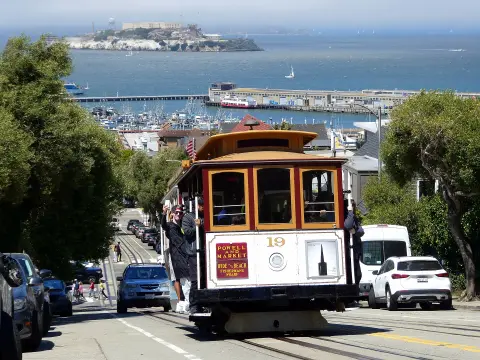
The cable cars belong to the same era. In 1873 Andrew Hallidie ran the first cable car on Clay Street, right here on the edge of Chinatown. Cable lines soon spread across the city's hills. Today three lines survive: Powell-Hyde, Powell-Mason and California Street. In 1964 the system was named a National Historic Landmark. The Cable Car Museum sits inside the working powerhouse at Washington and Mason Streets. Admission to the museum is free, and the machinery you see there is not a display. It is the real engine room of the system.
The setting
Chinatown fills roughly a dozen steep blocks between the Financial District and Nob Hill. Grant Avenue is the main visitor street, lined with shops, restaurants and lantern strings. One block west, Stockton Street is where locals buy fish, produce and roast meats. Between them run narrow alleys such as Waverly Place and Ross Alley, with painted balconies and family association buildings. The buildings are mostly brick from the rebuilding after 1906, many topped with curved tile roofs. The cable car tracks cross the area on California Street and run along its western edge on Powell and Mason. The museum occupies a red brick powerhouse and carbarn, where you can stand on a gallery above the actual machinery.
Why it matters
Chinatown is a living record of Chinese American history, with all its struggles and its endurance. Its family associations, temples and churches still serve residents, and the neighbourhood remains a cultural home for Chinese Americans across the Bay Area. The cable cars matter too. They are described as the last manually operated cable car system in the world, and they still carry passengers every day. Seeing both on one walk shows how San Francisco's past is still in daily use, not locked behind glass.
Your walk-through
The stops a guide would take you to, in order.
-
1
Dragon Gate at Grant Avenue and Bush Street
Begin at the Dragon Gate, the southern entrance to Chinatown, dedicated in 1970. Three Chinese American designers won the competition to create it, and the Republic of China in Taiwan donated its roof tiles and stone lions. Look up at the central inscription. It is a phrase associated with Sun Yat-sen, usually translated as 'All under heaven is for the good of the people.'
-
2
Old St. Mary's Cathedral
Walk up Grant Avenue to the brick church on the corner of California Street. Old St. Mary's was dedicated at Christmas in 1854, the first cathedral of the Archdiocese of San Francisco. Look under the clock for the words 'Son, observe the time and fly from evil.' The warning was aimed at men heading for the brothels nearby. Fire gutted the church in 1906, but its walls and tower survived.
-
3
Grant Avenue shops
Continue north along Grant Avenue. Look above the shopfronts at the pagoda roofs and painted balconies. Most of these were designed after 1906, when merchants rebuilt Chinatown in a style meant to draw visitors. Notice too the lanterns, the herbal shops and the bakeries. Many families have run businesses on this street for generations.
-
4
Tin How Temple on Waverly Place
Turn onto Waverly Place and look for 125, a building with a red and gold balcony. On the top floor is Tin How Temple, dedicated to Mazu, the sea goddess who protects travellers. It was founded in the early 1850s and is one of the oldest Chinese temples in the United States. If the attendant welcomes you, climb the stairs quietly. Photography is not allowed inside, and a small donation is appreciated.
-
5
Ross Alley
Cut through to Ross Alley, one of the oldest alleys in the city. It is narrow, a little crooked, and full of murals. Here you will smell sweet batter from a small fortune cookie bakery, where workers fold cookies by hand. Fortune cookies, as Americans know them, are a California creation rather than a Chinese one. Buy a bag and read your fortune as you walk.
-
6
Cable Car Museum at Washington and Mason
Finally, climb Washington Street toward Nob Hill and step into the Cable Car Museum. From the gallery you look down on huge spinning wheels, called sheaves, pulling steel cables beneath the streets at a steady speed. Every cable car in the city clamps onto these moving cables. Downstairs you can see where they run out under the road. Then look at the historic cars, including early cars from the 1870s.
Things you might not know
- San Francisco's Chinatown is the oldest Chinatown in North America.
- The cable car system was declared a National Historic Landmark in 1964.
- Old St. Mary's Cathedral was built with brick shipped around Cape Horn and granite cut in China.
Researched November 2026 from: en.wikipedia.org, en.wikipedia.org, en.wikipedia.org, cablecarmuseum.org. Fees and hours change, so check on the day.