⭐ Must-see · Embarcadero, 3 km from central San Francisco
Ferry Building Marketplace
A clock tower, ferry horns and the taste of California
🎧 Listen to this guide · about 6 min
Pop your earphones in and we'll walk you round.
Welcome to the Ferry Building. Look up at that clock tower. For more than a century it has watched over the waterfront at the foot of Market Street. Once tens of thousands of people poured through here every day, off the ferries and into the city. Today they come for the food. Inside, under a long skylit hall, you will find bakers, cheesemakers, oyster bars and coffee roasters. On market days the plaza outside fills with farmers selling stone fruit, citrus, greens and flowers. The air smells of fresh bread and salt water. Ferries still come and go behind the building. So grab a coffee, taste a peach, and let me show you why this old terminal is one of the city's favourite places.
The story of Ferry Building Marketplace
The Ferry Building was designed by the New York architect A. Page Brown in 1892 and opened on 13 July 1898. Before the bridges were built, it was the main gateway to San Francisco. Trains from across the country ended across the bay in Oakland, and passengers finished the journey by ferry. For decades this was one of the busiest transit terminals in the world.
The building survived the 1906 earthquake with little damage, and its clock tower became a symbol of a city that would rebuild. But in the late 1930s the Bay Bridge and the Golden Gate Bridge opened, and ferry traffic collapsed. In the late 1950s the double-deck Embarcadero Freeway was built right in front of the building, cutting it off from the city. The grand hall was carved up into offices.
The turning point came with the Loma Prieta earthquake in 1989. The freeway was damaged, and the city chose to tear it down and replace it with an open boulevard. The waterfront could breathe again. The Ferry Plaza Farmers Market had begun in 1993, and a long restoration followed. The renovated building reopened in 2003 with its nave restored and a marketplace of local food producers on the ground floor.
The setting
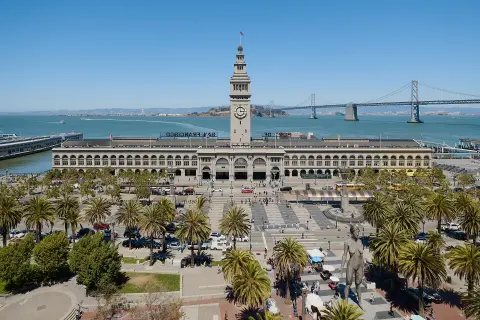
The Ferry Building stands at the foot of Market Street on the Embarcadero, the city's waterfront boulevard. It is long and low, faced in pale stone, with a clock tower 245 feet tall at its centre. People often say the tower was modelled on the Giralda in Seville, though historians have found no firm evidence of that. Inside, the ground floor marketplace runs the length of the building, with shops on both sides. Upstairs, under a long skylight, is the restored nave. Behind the building are the ferry docks, with boats to Sausalito, Larkspur, Oakland and Vallejo. Out front and along the south side, the farmers market sets up its stalls. The Bay Bridge rises just to the south.
Why it matters
The Ferry Building shows how a city can repair a mistake. Removing the freeway reconnected San Francisco to its waterfront and made the Embarcadero a place people walk, cycle and linger. The marketplace and farmers market helped make the Bay Area known for seasonal, locally grown food, and they still give small farms and producers a public stage. Ferries here also remain part of daily transport for commuters across the bay. Inside and out, it is where locals and visitors mix, shopping side by side on a Saturday morning.
Your walk-through
The stops a guide would take you to, in order.
-
1
The plaza and clock tower
Begin on the plaza facing the building. Look up at the clock tower, 245 feet tall. After the 1906 earthquake, it was one of the few things on this waterfront still standing. Behind you, Market Street runs straight up toward Twin Peaks. The F Market historic streetcars, painted in the colours of cities around the world, clatter past along the Embarcadero.
-
2
The farmers market stalls
On Tuesdays, Thursdays and Saturdays, walk among the farmers market stalls. Saturday is the big one. Ask the growers what is in season. In late autumn and winter look for citrus, persimmons, apples and dark greens. In summer the tables overflow with peaches, tomatoes and berries. Many vendors offer tastes. This market has run here since 1993 and is one of the best known in the country.
-
3
The marketplace hall
Step inside and walk the long marketplace hall. You will pass bakeries, cheesemongers, mushroom sellers, chocolate makers and oyster bars. Most of them are Bay Area businesses that sell what they make. Look up at the arches and the mosaic floor. The restoration brought back much of the original detail that had been hidden under decades of office partitions.
-
4
The upper nave
Climb the stairs to see the restored nave from above. A long skylight runs down the centre, and steel trusses carry the roof. Imagine this hall in the early twentieth century, packed with commuters rushing for their boats. From up here you can understand how the building was designed to move huge crowds quickly between the city and the water.
-
5
Behind the building at the ferry docks
Finish behind the building, on the bay side. This is the working ferry terminal. Watch the boats come and go to Sausalito, Larkspur and Oakland. To your right the Bay Bridge stretches toward Yerba Buena Island. Find a bench, eat what you bought, and listen to the gulls and ferry horns. It is one of the best free views in the city.
Things you might not know
- The Ferry Building opened in 1898 and survived the 1906 earthquake with little damage.
- The Embarcadero Freeway that once blocked it was removed after the 1989 Loma Prieta earthquake.
- The clock tower stands 245 feet tall.
Researched November 2026 from: en.wikipedia.org, foodwise.org, ferrybuildingmarketplace.com. Fees and hours change, so check on the day.