⭐ Must-see · Marina District, 6 km from central San Francisco
Palace of Fine Arts
A romantic ruin built for a world's fair
🎧 Listen to this guide · about 5 min
Pop your earphones in and we'll walk you round.
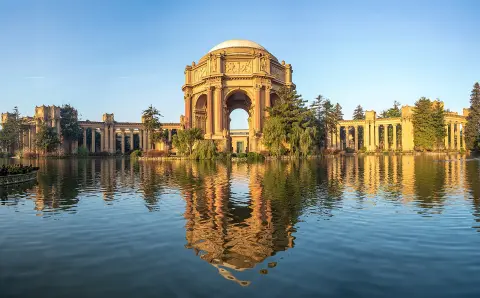
Welcome to the Palace of Fine Arts. Come around the lagoon slowly and let it reveal itself. First the reflection, then the great dome, then the curving rows of columns. Swans and ducks drift across the water. Willows trail their branches at the edge. It looks ancient, like something from Rome or Greece. In fact it was built in 1915 for a world's fair, and its architect wanted it to look like a ruin from the very start. Many locals come here to walk, to sit by the water, or to take wedding photos. It is calm, gracious and completely free. Let us walk the lagoon path together and then stand under the dome.
The story of Palace of Fine Arts
In 1915 San Francisco hosted the Panama-Pacific International Exposition. It celebrated the opening of the Panama Canal, and it showed the world that the city had recovered from the earthquake and fire of 1906. A temporary city of palaces rose on filled land along the bay, in what is now the Marina District. The architect Bernard Maybeck designed the Palace of Fine Arts to display paintings and sculpture. He imagined a melancholy classical ruin, drawing on Roman and Greek buildings, an etching by Piranesi and the painting Isle of the Dead by Arnold Böcklin.
When the fair ended, almost every building was torn down. People loved the Palace too much to let it go. But it had been built of wood, plaster and fibre, meant to last only a year, and by the 1950s it was crumbling. A campaign to save it began in 1958, and the state helped pay for reconstruction. The original was demolished in 1964 and rebuilt in concrete and steel, with the work completed by 1974.
The Exploratorium science museum occupied the exhibition hall from 1969 until 2013, when it moved to the waterfront. A restoration in the 2000s repaired the dome, rotunda, colonnades and lagoon.
The setting
The Palace sits at the western end of the Marina District, near the Presidio and the Golden Gate Bridge. Its centrepiece is an open rotunda 162 feet high, with a dome carried on huge columns but no walls. Two curving colonnades sweep out from the rotunda and frame the lagoon. Behind them is the long curved exhibition hall, now used as an event space. Look at the tops of the colonnades. Planter boxes rise above the columns, and on each corner stands a sculpted woman facing inward, as if gazing into the box. People often call them the weeping women. The lagoon in front is ringed by a path, lawns and trees.
Why it matters
The Palace of Fine Arts is the only structure from the 1915 exposition still standing on its original site. It is a San Francisco Designated Landmark and is listed on the National Register of Historic Places. It shows how much ordinary residents value beauty in public space. They saved a building that was never meant to survive. Today it is a free, open place for everyone, used for strolls, picnics, photos and celebrations. It is also a link to 1915, when a battered city invited the world to celebrate its comeback.
Your walk-through
The stops a guide would take you to, in order.
-
1
The lagoon's eastern shore
Start on the eastern side of the lagoon, near Baker Street. This is the classic view, with the dome reflected in the water. Early morning is best, when the surface is still. Watch for swans, ducks and turtles. The lagoon is a remnant of the 1915 fair grounds, which once stretched along this whole shoreline.
-
2
Lagoon path under the willows
Follow the path around the water. You pass weeping willows, eucalyptus and lawns where families picnic. As you walk, the colonnades seem to move in and out of view through the trees. Maybeck wanted exactly this effect. He designed the Palace to be seen across water and through greenery, like a temple rediscovered in a garden.
-
3
The colonnade
Step onto the colonnade and walk between the giant columns. Look up at the planter boxes on top. On each corner a carved woman stands with her face turned toward the box, her arms resting on it. People often call them the weeping women. Some say Maybeck meant them to express the sadness of art, but that is interpretation rather than recorded fact.
-
4
Under the rotunda
Now stand in the middle of the rotunda, 162 feet below the top of the dome. Look up at the painted panels and the carved figures around the rim. Clap your hands or speak softly and listen to how the sound comes back to you. The rotunda has no walls at all, so the breeze from the bay moves straight through.
-
5
The exhibition hall facade
Walk behind the rotunda to the long curved exhibition hall. Paintings and sculptures from around the world filled it in 1915. Later it held tennis courts, military vehicles and city offices. For more than four decades it housed the Exploratorium, where generations of Bay Area children learned science by touching things. Today it hosts events and exhibitions.
Things you might not know
- Maybeck designed the Palace to look like a classical ruin from the start.
- The original wood and plaster building was demolished in 1964 and rebuilt in concrete and steel.
- It is the only structure from the 1915 exposition that survives on its original site.
Researched November 2026 from: en.wikipedia.org, palaceoffinearts.org, sfrecpark.org. Fees and hours change, so check on the day.