🚗 Day trip · Harpers Ferry, West Virginia, 105 km from central Washington, D.C.
Harpers Ferry National Historical Park
Two rivers, three states and a turning point in history
🎧 Listen to this guide · about 5 min
Pop your earphones in and we'll walk you round.
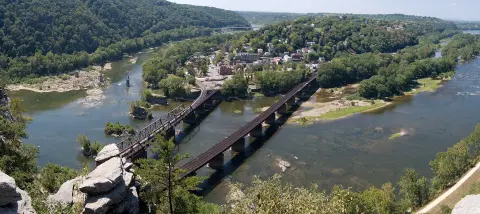
Welcome to Harpers Ferry. Look around. Steep wooded mountains rise on every side. Two rivers, the Potomac and the Shenandoah, meet just below you in a rush of white water. Maryland, Virginia and West Virginia all come together here. The old town climbs the hillside in stone and brick. This small place played a huge part in American history. It had a federal armoury, it saw John Brown's raid on the eve of the Civil War, and it changed hands many times during that war. Today it is a national park. We will walk through Lower Town, climb to Jefferson Rock and look out over the rivers.
The story of Harpers Ferry National Historical Park
The town takes its name from Robert Harper, who ran a ferry here in the 1700s. In 1783 Thomas Jefferson visited and wrote that the view was worth a voyage across the Atlantic. In 1799 the federal government began building an armoury here, and it became a major centre for making rifles and muskets.
On October 16, 1859, the abolitionist John Brown led a group of about twenty men in a raid on the armoury. He hoped to start an uprising against slavery. The raid was put down within two days by US Marines under Robert E. Lee. Brown was tried and hanged in December 1859. The raid deepened the divisions that led to the Civil War.
During the war the town changed hands many times. In September 1862, Confederate forces under Stonewall Jackson captured more than 12,000 Union troops here, the largest surrender of US troops in the war. After the war, Storer College opened in 1867 to educate formerly enslaved people. In 1906 it hosted a meeting of the Niagara Movement, a forerunner of the NAACP. The town became a national park in the 1940s.
The setting
Harpers Ferry sits on a narrow point of land where the Shenandoah flows into the Potomac, at the edge of the Blue Ridge Mountains. Lower Town, near the water, is a cluster of restored buildings, now museums and exhibits. Stone steps lead up to Upper Town, the churches and Jefferson Rock. Across the Potomac rise the cliffs of Maryland Heights. The Appalachian Trail runs through the town and over a footbridge across the Potomac. It is a steep, hilly place, with spectacular views at almost every turn.
Why it matters
Harpers Ferry brings together many threads of American history in one compact place: early industry, the struggle over slavery, the Civil War and the fight for civil rights. Its buildings and exhibits let visitors see these stories where they happened. It is also a gateway to the outdoors, with hiking, river trips and the Appalachian Trail. Few places give you so much history and natural beauty in a single day trip from Washington.
Your walk-through
The stops a guide would take you to, in order.
-
1
Lower Town
Start in Lower Town, where the shuttle from the visitor centre drops you. Walk along Shenandoah Street. The restored buildings house museums about the town's industry, daily life and the Civil War. Look into the old dry goods store and the blacksmith's shop. It feels like stepping back into the 1800s.
-
2
John Brown's Fort
Find the small brick building near the river. This was the armoury's fire engine house. In October 1859, John Brown and his remaining men took refuge here with hostages. Marines broke in and captured him. The building has been moved several times, and now stands close to its original site. Read the exhibits nearby on the raid and its aftermath. This is a place where violence began a chain of events that led to war.
-
3
The Point
Walk to the tip of land where the two rivers meet. To your left is the Potomac, to your right the Shenandoah. Across the water are Maryland and Virginia. The railroad bridge crosses above. Stand here and listen to the water. This is the view Jefferson admired.
-
4
St. Peter's Catholic Church
Climb the stone steps cut into the hillside. Halfway up you reach St. Peter's, a Catholic church with a tall spire. It was built in the 1830s and rebuilt later in the century. So the story goes, it was spared damage in the Civil War because the priest flew a British flag. Look back down at the rooftops of Lower Town.
-
5
Jefferson Rock
Keep climbing to Jefferson Rock, a large flat stone balanced on others. Thomas Jefferson is said to have stood here in 1783 and admired the view. Supports were added later to keep the rock stable. From here you see the rivers, the mountains and the town below. It is a fine spot to rest.
-
6
Potomac footbridge
Finish by walking back down and across the footbridge over the Potomac, part of the Appalachian Trail. In the middle, look up and down the river. On the far side you reach the C&O Canal towpath in Maryland. Many hikers pass through here. The views back to the town are among the best of the day.
Things you might not know
- In September 1862, more than 12,000 Union soldiers surrendered at Harpers Ferry, the largest surrender of US troops during the Civil War.
- John Brown's raid on the federal armoury began on October 16, 1859, and was put down within two days.
- The Appalachian Trail passes through the town, which is home to the headquarters of the Appalachian Trail Conservancy.
Researched November 2026 from: nps.gov, nps.gov, nps.gov, en.wikipedia.org. Fees and hours change, so check on the day.