⭐ Must-see · National Mall, 1 km from central Washington, D.C.
Smithsonian National Museum of Natural History
Dinosaurs, diamonds and the long story of life
🎧 Listen to this guide · about 6 min
Pop your earphones in and we'll walk you round.
Step through the doors and look up. An African bush elephant stands in the middle of a domed rotunda, trunk raised, as if it has just walked in from the savanna. Welcome to the National Museum of Natural History. This is one of the most visited museums in the world, and it costs nothing to enter. Inside are dinosaurs, meteorites, a blue diamond with a famous story, and halls about human origins and the ocean. You cannot see it all in one visit. So today we will follow a simple route, from the rotunda to the fossils, then upstairs to the gems. Pick up a map at the door, and let's go.
The story of Smithsonian National Museum of Natural History
The museum belongs to the Smithsonian Institution, which owes its existence to an unusual gift. James Smithson, a British scientist who never visited the United States, left his fortune to found an establishment for the increase and diffusion of knowledge. Congress created the Smithsonian in 1846.
The collections grew quickly, and by the early 1900s they needed far more space. This building, designed by the firm Hornblower and Marshall, opened its doors in 1910. It was one of the first buildings on the north side of the Mall to follow the new McMillan plan for the area.
The museum has changed with the science. In 1958 the jeweller Harry Winston donated the Hope Diamond, famously sending it by registered mail. The elephant has stood in the rotunda since 1959. More recently, the Hall of Human Origins opened in 2010, and the fossil hall reopened in 2019 after a five-year rebuild, now called the David H. Koch Hall of Fossils, Deep Time. Behind the public halls, scientists still study a collection of well over 140 million specimens.
The setting
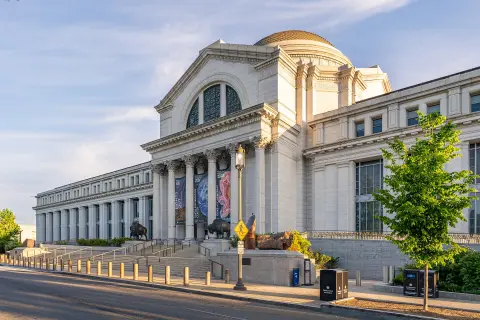
The building is a grand Beaux-Arts design with a green dome and a columned entrance facing the Mall. Inside, the rotunda is the hub. Halls open off it in every direction across three public floors. On the ground floor you will find the ocean hall to one side and the fossil hall to the other. The second floor holds the gems and minerals, human origins and changing exhibits. Ceilings are high and the light is soft. On busy days the rotunda gets loud, but the side halls are calmer. There is a café and restrooms on the ground floor, and a second entrance on Constitution Avenue that often has a shorter security line.
Why it matters
This museum is a public window on a working research institution. The specimens on display are a small fraction of what is kept here, and scientists use the collections to study climate, evolution and biodiversity. For visitors, it is a place where children see their first real dinosaur and adults rethink how long the Earth has been around. It is free, open every day but one, and right in the middle of the Mall, which makes it one of the easiest great museums in the world to visit.
Your walk-through
The stops a guide would take you to, in order.
-
1
The rotunda elephant
Start right here under the dome. This is an African bush elephant, one of the largest mounted specimens anywhere, and it has stood in this spot since 1959. Walk all the way around it. Look at the ears, which help an elephant shed heat, and at the wrinkled skin. It is the museum's unofficial meeting point. If anyone in your group gets lost today, this is where to come back to.
-
2
Hall of Fossils, Deep Time
Head into the fossil hall. It tells the story of life over billions of years, and it ends with a question about our own impact on the planet. The centrepiece is a Tyrannosaurus rex posed in the act of attacking a Triceratops. Look for the windows into the fossil lab, where you can sometimes watch staff cleaning bones. Take time with the smaller cases too. Ancient plants and insects tell the story as well as the giants do.
-
3
Sant Ocean Hall
Cross the rotunda to the ocean hall. Hanging overhead is a full-size model of a North Atlantic right whale, a species that is now very rare. Around you are displays on deep-sea creatures, coral and the giant squid. Look for the specimen of a giant squid, preserved in fluid. The hall is a reminder that the ocean covers most of the planet, and that much of it is still unexplored.
-
4
Hall of Human Origins
Go upstairs to the second floor. This hall traces how humans evolved over about six million years. You will see skulls, tools and life-size reconstructions of early human faces, made from fossil evidence. There is a station where you can see what you might look like as an early human. It is popular with families, and it makes a big subject feel personal.
-
5
The Hope Diamond
Now to the gem hall and the most famous stone in the building. The Hope Diamond weighs 45.52 carats and has a deep blue colour, caused by small amounts of boron in the crystal. It was cut from a larger blue diamond once owned by the kings of France. It is said to carry a curse, though that story appears to have been spread by sellers in the early 1900s. Under ultraviolet light, the diamond glows a red-orange that lingers for a moment afterward.
-
6
Minerals and meteorites
Before you leave, wander the mineral gallery next door. Cases glow with crystals in every colour, from deep purple amethyst to bright green malachite. Near the end are meteorites, pieces of other worlds that fell to Earth. Some formed at the very birth of the solar system, about four and a half billion years ago. It is a quiet way to end, looking at something that came from space.
Things you might not know
- Harry Winston donated the Hope Diamond to the Smithsonian in 1958 and sent it to the museum by registered mail.
- James Smithson, whose bequest founded the Smithsonian, never visited the United States.
- The museum's collections hold well over 140 million specimens and artefacts, most of them stored behind the scenes for research.
Researched November 2026 from: naturalhistory.si.edu, si.edu, en.wikipedia.org, en.wikipedia.org. Fees and hours change, so check on the day.