💎 Hidden gem · Kenilworth, Northeast Washington, 10 km from central Washington, D.C.
Kenilworth Park and Aquatic Gardens
Lotus ponds and a wild marsh on the Anacostia
🎧 Listen to this guide · about 5 min
Pop your earphones in and we'll walk you round.
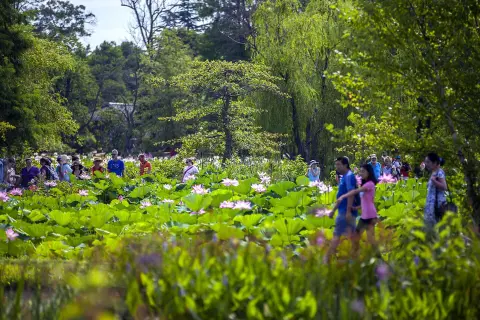
Welcome to Kenilworth Aquatic Gardens. You might not expect to find this in a capital city. Ahead are dozens of ponds, filled with water lilies and lotus. In July, the lotus leaves stand high above the water, and pink and white flowers open in the morning light. Beyond the ponds is a tidal marsh, home to herons, turtles and frogs. A boardwalk carries you right out into it. This is a National Park Service site, it is free, and it is often almost empty. We will walk the ponds first, then head out onto the marsh boardwalk. Bring water and sun protection in summer.
The story of Kenilworth Park and Aquatic Gardens
The gardens began with one man's hobby. In the 1880s, Walter B. Shaw, a veteran of the Civil War, bought land here beside the Anacostia River. Missing his home state of Maine, he planted wild water lilies from there in a pond. They did well, and he added more ponds and more varieties.
By 1912 Shaw had turned the gardens into a business called the W.B. Shaw Lily Ponds. After he died in 1921, his daughter, Helen Shaw Fowler, ran it. She travelled to bring back new plants and drew many visitors, including presidents. Silt in the Anacostia and dredging plans threatened the gardens, and Helen fought to save them. In 1938 Congress authorised the purchase of the gardens for 15,000 dollars, and they became a national park.
In 1951, a park botanist named Horace Wester succeeded in sprouting lotus seeds that had been found in a dry lakebed in China in the 1920s. Research at the time suggested they were over 400 years old. In the 1990s, restoration work brought back 32 acres of tidal marsh beside the gardens.
The setting
The park covers about 700 acres, including the marsh, along the east bank of the Anacostia River. The ponds sit in a neat grid near the visitor centre, separated by grassy paths. Each pond holds different plants: hardy water lilies, tropical lilies and the tall American and Asian lotus. Beyond them, the land drops into the Kenilworth Marsh, a tidal wetland that rises and falls with the river. A boardwalk crosses part of the marsh, and a river trail leads to views of the Anacostia. It is flat, open and sunny, with a few shady trees.
Why it matters
Kenilworth is the only National Park Service site devoted to aquatic plants. It is also an important wildlife habitat in the middle of a city, and a sign of how the Anacostia River is being restored after decades of pollution. For people who live nearby, it is a much loved neighbourhood park. For visitors, it is a peaceful, free escape from the monuments, and a chance to see flowers and birds you would never expect so close to the Capitol.
Your walk-through
The stops a guide would take you to, in order.
-
1
Visitor centre
Start at the small visitor centre. Here you can pick up a map and learn about the Shaw family and the plants. Behind it is a concrete display pond. It is one of the first places where lotus blooms each year. Ask a ranger what is flowering today. They can tell you which ponds to see first.
-
2
The lily ponds
Walk out among the ponds. Look for the hardy water lilies, with flat round pads and flowers floating on the surface. The tropical lilies hold their flowers higher, and some bloom at night. Look closely at the pads. You may spot frogs sitting still, or dragonflies landing. In summer, flowers open in the morning and close by afternoon, so come early.
-
3
The lotus ponds
Now the lotus. Their round leaves rise well above the water, sometimes higher than your head. The big flowers are pink or creamy yellow. After they fade, you see the seed pods, which look like shower heads. Rain rolls off the leaves in silver beads, because their surface repels water. In many Asian cultures the lotus is a symbol of purity, because it grows from mud yet stays clean.
-
4
Marsh boardwalk
Head to the boardwalk and walk out into the marsh. On each side are cattails, wild rice and grasses. The water level here rises and falls with the river tides. Watch for great blue herons standing still in the shallows, and turtles sunning on logs. In spring and autumn, migrating birds stop here. Walk slowly and quietly. You will see more.
-
5
River trail
Finish on the river trail, which leads toward the Anacostia. Here the river is wide and quiet. Once it was one of the most polluted rivers in the region. Decades of clean-up work are slowly bringing it back, and you can see fishermen, kayakers and eagles along it today. Stand by the water for a moment before heading back to the ponds.
Things you might not know
- The gardens began in the 1880s when Civil War veteran Walter B. Shaw planted water lilies from his home state of Maine.
- Congress authorised buying the gardens in 1938 for 15,000 dollars.
- In 1951 a park botanist here sprouted lotus seeds from a dry lakebed in China that were then thought to be over 400 years old.
Researched November 2026 from: nps.gov, nps.gov, en.wikipedia.org. Fees and hours change, so check on the day.