🚗 Day trip · Amboli, Maharashtra, 120 km from central Goa
Amboli Waterfall
By the Tralover editorial team · Fact-checked · How we research
Mist, rain and water falling through the Ghats
🎧 Listen to this guide · about 5 min
Pop your earphones in and we'll walk you round.
Welcome to Amboli. Feel the air. After the heat of the coast, it is cooler here, sometimes misty, and smells of wet earth and forest. We are about 700 metres up in the Western Ghats, in Maharashtra, at the last hill station before the mountains drop to the plains of Goa. Amboli is one of the wettest places in the state, and in the monsoon its hills pour with waterfalls. The most famous one tumbles down right beside the road, and people stop to stand under the spray, laugh and take pictures. Outside the rains the falls shrink, but the forest, views and wildlife are still here. Watch your step. The rocks are slippery.
The story of Amboli Waterfall
Amboli began as a stop on an old road. In the nineteenth century, the British used the route from the port of Vengurla on the coast, up through these hills, to Belgaum on the Deccan plateau, to supply their garrisons inland. Amboli grew as a resting place on that climb.
Over time it became a small hill station, a cool retreat from the coastal heat. Many men from the area served in the army, before and after Indian independence. The village stayed small and simple, surrounded by forest.
In more recent decades Amboli has become known for two things. The first is the monsoon. With heavy rainfall, averaging several metres a year, the hillsides come alive with waterfalls from June to September, and crowds come from Goa, Kolhapur and beyond. The second is wildlife. Scientists have found many species here that live nowhere else, and some are named after the place itself, such as the Amboli bush frog. Today Amboli is a favourite for nature lovers, birdwatchers and people looking for a misty day out from Goa.
The setting
Amboli sits on a ridge at the edge of the Western Ghats, where the land falls away steeply toward the coast. The main waterfall drops down a rocky cliff beside the main road, just below the village, with steps leading up toward the falls. Around it are thick evergreen and semi evergreen forests, deep valleys and viewpoints like Sunset Point and Mahadevgad Point. The Hiranyakeshi River rises near the village at a cave with a small Shiva temple. In the monsoon everything is green and wet, with clouds drifting through the trees. In the dry season the air clears and the views open up.
Why it matters
Amboli is part of the Western Ghats, one of the world's richest regions for plants and animals. It is home to rare frogs, lizards, snakes, butterflies and plants, many found only in these hills. Researchers and nature groups have worked hard to document and protect them, as development and forest loss are real threats. For visitors from Goa, Amboli offers a different landscape, cool and green, and a reminder of how important these mountains are for the rivers and rain that feed the whole coast.
Your walk-through
The stops a guide would take you to, in order.
-
1
The roadside view
Begin by the road, just below the main waterfall. Look up and see the water tumbling down the rock face, in full flow in the monsoon, thinner in the dry months. Around you, stalls sell hot tea, corn on the cob and fried snacks. It is a lively, cheerful scene.
-
2
The steps to the falls
Climb the steps beside the waterfall. In the rains, you can stand close and feel the spray, or even step under it where it is safe. The rocks are slippery, so go slowly, hold the railings, and keep away from the strongest flow. Out of season, the pools and rocks are quieter and easier to explore.
-
3
The forest edge
Look carefully at the forest edges and the wet rocks. Amboli is famous for its frogs, including the Amboli bush frog, named after this very place. You may also spot colourful butterflies, beetles and birds. Night walks with local naturalists are a popular way to see the wildlife, but go only with a guide.
-
4
Hiranyakeshi temple and source
If you have time, drive a short distance to the Hiranyakeshi temple. Here, from a cave in the hillside, the Hiranyakeshi River begins its journey, and a small Shiva temple stands at its mouth. The water is cool and clear, and the setting is peaceful and green.
-
5
Sunset Point
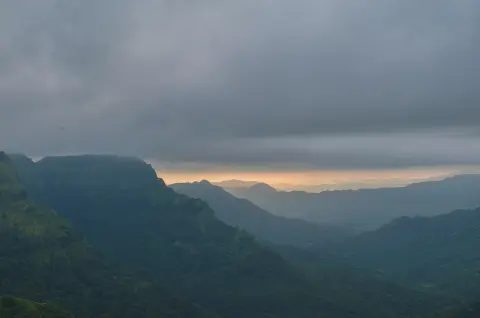
End your visit at Sunset Point. From here you look down over steep forested slopes toward the Konkan coast and Goa. On clear evenings the sun sinks toward the distant sea. In the monsoon you may see only clouds, drifting past like smoke, which has its own magic.
Things you might not know
- Amboli sits at about 700 metres in the Western Ghats.
- It receives several metres of rain a year, averaging around seven metres.
- The Amboli bush frog is named after the village.
Researched November 2026 from: en.wikipedia.org, en.wikipedia.org. Fees and hours change, so check on the day.