🚗 Day trip · Anjuna, North Goa, 80 km from central Goa
Anjuna Beach
By the Tralover editorial team · Fact-checked · How we research
Red cliffs, a Wednesday market and the ghosts of the hippie trail
🎧 Listen to this guide · about 5 min
Pop your earphones in and we'll walk you round.
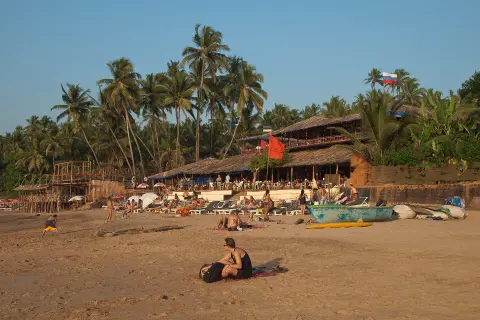
Welcome to Anjuna. This is a beach with a story. Unlike the smooth, open sands of the south, Anjuna is all character: low red laterite cliffs, black rocks running into the surf, palm trees and small cafes perched on the edge. On a Wednesday in season, the fields behind the beach fill with a sprawling flea market, full of colour, music and bargaining. In the evening people gather on the rocks to watch the sun sink into the sea. Anjuna was the first stop for the hippies who discovered Goa in the 1960s, and something of their easy spirit still lingers, mixed now with Goan village life, beach clubs and travellers of every age.
The story of Anjuna Beach
Long before the travellers came, Anjuna was a quiet village of fishermen, toddy tappers and farmers in the Bardez region, which came under Portuguese rule in the 1500s. The village church, dedicated to Saint Michael, was founded around the turn of the seventeenth century and still stands inland from the beach.
In the mid 1960s, Western travellers began to arrive along the overland hippie trail from Europe. Among the early arrivals was an American remembered as Eight Finger Eddie, who is often called the father of Anjuna's traveller scene. By the late 1960s and early 1970s, a community of foreigners was living here for months at a time, renting rooms from local families and gathering on the beach.
The flea market grew out of that world. So the story goes, travellers began meeting on Wednesdays to swap and sell their belongings, from clothes to cameras, to pay for the journey home. Over the decades local traders, Tibetan and Kashmiri sellers and artisans from across India joined in, and it became one of the best known markets in the country. Anjuna also gave its name to a style of trance music born at all night beach parties in the 1990s, though noise rules have since quietened those nights.
The setting
Anjuna is a small bay, roughly two kilometres long, framed by laterite headlands. The northern part is rocky, with flat black boulders and tidal pools, and the southern part has more sand. Cafes and shacks sit on the low cliffs above the water, and the flea market ground lies just behind the southern end, among palms and open land. A little further north you can see the walls of Chapora Fort on its hilltop above the Chapora River. Inland, the village spreads out along winding roads, with old Goan houses and the white facade of Saint Michael's Church.
Why it matters
Anjuna matters because it marks the moment Goa turned toward the wider world as a travel destination. The arrival of the hippies changed the local economy, from rented rooms to cafes to the market itself, and laid the groundwork for Goa's tourism industry. It is also a lively mixing point, where Goan families, Indian holidaymakers and foreign long stayers share the same sand. Visiting with an open mind, respecting the village and its rules, keeps that mix healthy.
Your walk-through
The stops a guide would take you to, in order.
-
1
The southern sand
Start on the southern end of the beach, where the sand is softest. On a quiet morning you may see fishermen pulling in boats and cows ambling past the shacks, as they do in many Goan villages. Look north and you will see the line of red cliffs and black rocks that give Anjuna its rugged face.
-
2
The flea market ground
Just behind the beach lies the flea market ground. If it is a Wednesday between roughly November and April, wander in. You will find silver jewellery, spices, sarongs, Kashmiri shawls, Tibetan trinkets and Goan cashews. Haggling is expected, but keep it friendly. Many of the sellers come from far away and travel the length of India for the season.
-
3
The rocky headland
Now walk north over the rocks. Take care, they can be slippery. At low tide small pools appear, full of crabs and tiny fish. These rocks are laterite and basalt, shaped by the waves into flat shelves. It is a good spot to sit, feel the spray, and imagine the early travellers camping here more than half a century ago.
-
4
The cliff top cafes
Climb up to the low cliffs where the cafes sit. Order a coffee or a coconut and look out over the bay. From here the whole of Anjuna lies at your feet, and on clear days you can see the coastline running north toward Vagator and Chapora.
-
5
Saint Michael's Church
If you have time, walk or ride a short way inland to Saint Michael's Church, the parish church of Anjuna. It was founded around 1600 and rebuilt over the years. Its white facade and quiet churchyard remind you that this is still a Goan Catholic village, with feasts, processions and family life going on behind the beach.
-
6
Sunset on the rocks
Come back to the rocks for sunset. The sky turns orange and pink, and people gather in small groups, some with guitars, some in silence. It is the oldest Anjuna ritual of all, and it costs nothing.
Things you might not know
- The Anjuna flea market traditionally runs on Wednesdays during the dry season.
- An American traveller known as Eight Finger Eddie, who arrived in the mid 1960s, is often called the father of Anjuna's traveller scene.
- Saint Michael's Church in Anjuna was founded around the turn of the seventeenth century.
Researched November 2026 from: en.wikipedia.org, lonelyplanet.com, gomantaktimes.com, atlasobscura.com. Fees and hours change, so check on the day.