⭐ Must-see · Bhagwan Mahaveer Sanctuary, Sanguem, 45 km from central Goa
Dudhsagar Falls
By the Tralover editorial team · Fact-checked · How we research
A sea of milk tumbling through the Western Ghats
🎧 Listen to this guide · about 5 min
Pop your earphones in and we'll walk you round.
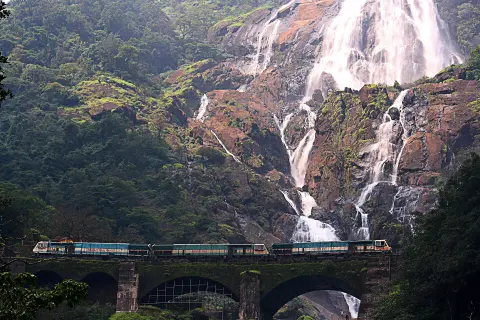
Welcome to the forest. Leave the beaches behind for a day. We are heading into the Western Ghats, the green mountain range that runs down India's west coast, to see Dudhsagar Falls. The name means Sea of Milk, and when you see the water foaming white down the dark rock face, you will understand why. The falls drop about 310 metres in four tiers, and halfway up, a railway line crosses right in front of them on a stone bridge. The ride in is part of the adventure: a bumpy jeep track through the forest, across streams and past tall trees. Keep your eyes open for monkeys, birds and butterflies. And keep your camera dry.
The story of Dudhsagar Falls
Dudhsagar lies in the high forest on the border between Goa and Karnataka, on the Mandovi River, also known as the Mahadayi. For centuries these hills were home to small forest communities and were crossed by trade paths between the coast and the Deccan plateau.
Legend says a princess once bathed in a lake at the top of the hills and drank sweetened milk from a golden jug. When she noticed a prince watching her, her maids poured the milk down the hillside to make a curtain and hide her, and the milk became the waterfall. It is a story children in Goa still hear.
In the late nineteenth century a railway was cut through these hills, linking the port of Mormugao to the interior at Londa in Karnataka. The line passes directly in front of the falls, and the view from the train became famous. The surrounding forest was later protected as the Bhagwan Mahaveer Wildlife Sanctuary, with Mollem National Park at its core. Today the Goa Forest Department controls access. Walking along the railway tracks is not allowed, and visitors come in licensed jeeps from Collem, with numbers limited each day.
The setting
The falls pour off a sheer, dark cliff into a wide, deep pool, surrounded by thick deciduous and evergreen forest. The river splits into several streams as it falls, giving the four tiered shape. About halfway up, the railway crosses on a curved stone viaduct, and trains sometimes pass right in front of the water. From the jeep drop point it is a short walk over rocks to the viewing area by the pool. In the monsoon, from June to September, the flow is at its most powerful but the forest track is closed. From October onward the water is still strong and the forest is lush.
Why it matters
Dudhsagar is the crown of Goa's inland landscape and a reminder that the state is far more than its coast. The falls sit inside one of the region's most important protected forests, home to gaur, the Indian bison, leopards, hornbills and many reptiles and butterflies. Seeing them helps visitors understand why the Western Ghats are counted among the world's richest areas for wildlife. Treating the place gently, with no litter and no plastic, keeps it that way.
Your walk-through
The stops a guide would take you to, in order.
-
1
The Collem jeep counter
Your day begins at Collem, at the edge of the sanctuary. Here you buy a seat in a licensed jeep, along with your forest entry and a life jacket if you want to swim. Jeeps leave once they fill, usually with six or seven people. Have cash ready, and expect a queue on weekends.
-
2
The forest track
Hold on tight. The jeep track winds for about 12 km through the sanctuary, crossing streams and bouncing over rocks. Look out for langur monkeys in the trees and brightly coloured butterflies along the water. The forest here is a mix of tall deciduous trees and evergreens, thick and green after the rains.
-
3
The walk to the pool
From the drop point you walk the last stretch on foot, over rocks and roots. Listen. You will hear the falls before you see them, a deep roar getting louder with each step. Watch your footing, wear proper shoes, and stay on the path.
-
4
The viewing pool
And there it is. The water falls from high above in white streams down the black rock, then crashes into the pool at your feet. The spray drifts over you and the air feels cool. If swimming is allowed when you visit, wear your life jacket and stay close to the edge. Fish nibble at your toes in the shallows.
-
5
The railway bridge
Look up at the stone viaduct halfway up the falls. This is the railway line between Goa and Karnataka, built in the late nineteenth century. If you are lucky, a train will cross while you are here, framed by the falling water. It is one of the most famous railway views in India.
Things you might not know
- Dudhsagar means Sea of Milk in Konkani.
- The falls drop about 310 metres in four tiers, making them one of India's tallest.
- A railway line between Goa and Karnataka passes directly in front of the falls.
Researched November 2026 from: en.wikipedia.org, freepressjournal.in, holidify.com. Fees and hours change, so check on the day.