💎 Hidden gem · Geumjeong-gu, 13 km from central Busan
Beomeosa Temple
By the Tralover editorial team · Fact-checked · How we research
The temple of the golden fish on Geumjeong Mountain
🎧 Listen to this guide · about 5 min
Pop your earphones in and we'll walk you round.
Welcome to Beomeosa. We have left the sea behind and climbed into the forest on Geumjeong Mountain. Listen. The city noise is gone. Instead there is wind in the trees, a stream somewhere below, and maybe the deep note of a temple bell. Beomeosa has stood on this slope for well over a thousand years, and it is still home to monks who live, study and pray here. As we walk up through the gates, the halls rise one above another, painted in soft greens and reds. Take your time. Walk gently. This is a working temple, and its calm is part of the welcome.
The story of Beomeosa Temple
Beomeosa was founded in 678, during the Silla kingdom, by royal decree of King Munmu. It was one of the ten major temples of the Hwaeom school of Buddhism, and the great monk Uisang is closely linked with its early years.
The name has a lovely legend behind it. Beom means heaven or nirvana, eo means fish, and sa means temple. Near the summit of Geumjeongsan, so the story goes, a well in a rock never ran dry, and a golden fish came down from heaven to swim in it. The temple took its name from that fish.
During the Japanese invasions of 1592 to 1598, the temple was almost completely burned. Monks began rebuilding in the early 1600s. The One Pillar Gate and the main hall, Daeungjeon, date from this period, with the main hall rebuilt in 1614. Over the centuries, Beomeosa became one of the leading Zen temples of southern Korea, and today it is one of the head temples of the Jogye Order.
The setting
Beomeosa climbs the eastern slope of Geumjeongsan, on a series of stone terraces. You enter through a sequence of gates, each one higher than the last: the One Pillar Gate, the Gate of the Heavenly Kings, and the Gate of Non-Duality. Beyond them, the main courtyard opens up, with the main hall at the top of a flight of steps. A Silla-era three-storey stone pagoda stands in front. Around the main complex, smaller hermitages are scattered through the woods. In the valley below the temple, an old grove of wild wisteria tangles over the stream.
Why it matters
Beomeosa is a living centre of Korean Buddhism. Monks still train here, and the temple offers templestay programmes where visitors can join meals, meditation and early morning chanting. Its gates and halls are protected national treasures, including the three-storey pagoda and the main hall. For Busan, it is also a spiritual anchor, a place of forest and quiet just a short ride from the busy city below.
Your walk-through
The stops a guide would take you to, in order.
-
1
One Pillar Gate (Iljumun)
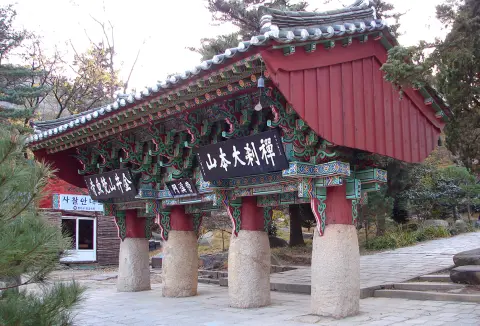
Here is the first gate, Iljumun, the One Pillar Gate. Stand to the side and look along it. The roof seems to rest on a single line of pillars, standing on tall stone bases. It symbolises the one true path to enlightenment. This gate dates from the early 1600s, after the invasions, and is a national treasure. Pass through and you are leaving the ordinary world behind.
-
2
Gate of the Heavenly Kings
Next comes the Gate of the Four Heavenly Kings. Inside stand four fierce guardians, painted in bright colours. They protect the four directions of the Buddhist world and keep evil away from the temple. Look at what they hold: a sword, a lute, a dragon and a pagoda. Their faces are meant to frighten demons, not visitors.
-
3
Three-storey stone pagoda
In the courtyard, look for the stone pagoda with three tiers. It dates from the Silla period, so it is over a thousand years old. Pagodas often hold sacred relics or texts. Walk slowly around it, in a clockwise direction, as many worshippers do. Notice how simple and balanced it is, compared with the painted halls around it.
-
4
Daeungjeon main hall
Climb the steps to the main hall, Daeungjeon. It was rebuilt in 1614 and its carved, painted eaves are some of the finest in Busan. Inside, gilded Buddhas sit on the altar. You may enter quietly by a side door, taking off your shoes. Do not walk through the central doorway, and if people are bowing, stay to the side.
-
5
Temple bell and drum pavilion
Near the courtyard is the pavilion with the great bell and drum. Each one has a meaning. The drum calls to animals on land, the fish-shaped wooden gong to creatures in the water, the cloud-shaped gong to birds, and the bell to beings in the underworld. If you are here in the late afternoon, you may hear them played for the evening service.
-
6
Wisteria valley
Before you leave, walk down into the valley beside the temple. Here, hundreds of old wild wisteria vines twist over the rocks and stream. They are a protected natural monument. In late April and May they bloom purple, and the air smells sweet. In other seasons the twisted trunks are still beautiful. From here, trails lead up toward the old Geumjeong mountain fortress.
Things you might not know
- Beomeosa was founded in 678, in the Silla kingdom.
- The temple's name means temple of the nirvana fish, after a legend of a golden fish from heaven.
- Its main hall was rebuilt in 1614 after the temple was burned during the Japanese invasions.
Researched November 2026 from: en.wikipedia.org, visitbusan.net, english.visitkorea.or.kr. Fees and hours change, so check on the day.