⭐ Must-see · Saha-gu, 9 km from central Busan
Gamcheon Culture Village
By the Tralover editorial team · Fact-checked · How we research
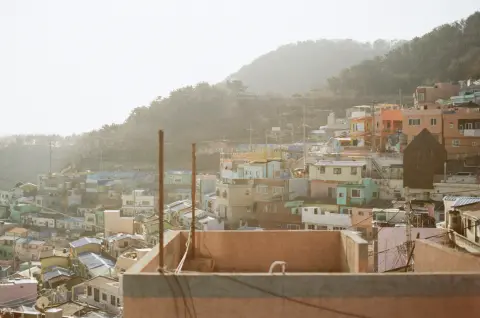
Pastel rooftops climbing a hill above the harbour
🎧 Listen to this guide · about 5 min
Pop your earphones in and we'll walk you round.
Welcome to Gamcheon. Stand here at the railing and look down. Hundreds of small houses tumble down the slope in pale blue, pink, yellow and mint green, one roof stacked on the next, all facing the sea. People sometimes call this place the Machu Picchu of Busan. It is a real neighbourhood, so remember that families live behind these doors. Speak softly in the alleys and do not peer into windows. In return, the village gives you murals, sculptures, tiny galleries and some of the best views over the port. Let us wander down the lanes together and follow the little painted fish on the walls.
The story of Gamcheon Culture Village
Gamcheon began in the 1920s and 1930s, when the city moved poor working families to this steep hillside, close enough to the port to supply labour. Life here was hard from the start. Houses were small, water was scarce and the slopes were steep.
In the 1950s, after the Korean War, the village grew quickly. In 1955 around 800 families of the Taegeukdo religious community settled here, and many refugees and poor workers joined them. They built houses in neat terraced rows, so that each home would not block the view, or the light, of the one behind it. That careful layout is why the village looks the way it does today.
For decades Gamcheon struggled with poverty and empty houses as younger people moved away. Then, in 2009, a public art project backed by the Ministry of Culture brought artists, students and residents together to decorate the village. Empty houses became galleries and studios, murals appeared on walls and stairways, and visitors started to come. The village is now one of Busan's most visited places, and it still balances tourism with daily life.
The setting
Gamcheon sits on the slopes between Cheonmasan and Okcheonbong, looking down toward the harbour. The houses rise in terraces along narrow lanes that follow the contours of the hill, connected by steep staircases. One main road runs along the upper edge, where you will find the information centre, cafes and shops. Below it, a maze of alleys drops away. Most houses are small, flat-roofed and painted in soft colours. Artworks are tucked into corners, on rooftops and along walls, and observation decks give wide views over the rooftops toward the sea.
Why it matters
Gamcheon matters because it is not a theme park. It is a working-class neighbourhood with a hard history that chose art as a way to survive. It shows how Busan absorbed refugees and poor families in the twentieth century, and how those communities shaped the city. Today it is a model for village regeneration in Korea. When you buy something from a resident-run shop or cafe, you help keep that story going.
Your walk-through
The stops a guide would take you to, in order.
-
1
Information centre and stamp map
Start at the information centre on the main road. You can pick up a village map here, often with spaces for stamps from different spots in the village. It is a fun way to make sure you do not miss the best corners. Look out from the terrace nearby. This is your first big view of the village, rooftops tumbling toward the harbour.
-
2
Fish murals along the lanes
As you head into the alleys, look for small painted fish on the walls. They swim in schools along the lanes and help guide you through the maze. It is easy to get turned around here, so the fish are both art and signposts. Follow them, take your time, and peek into the little galleries housed in former empty homes.
-
3
The Little Prince and the Fox
Here is the village's most photographed spot. A sculpture of the Little Prince sits on a ledge with the fox beside him, both gazing out over the rooftops. There is usually a queue for a photo. It is worth the short wait. Behind them, the whole village spreads out like a painted map.
-
4
Stairways and terraced houses
Take one of the long stairways down between the houses. Notice how each row sits slightly below the one above it, so no home blocks another's light. That was the work of the families who built this place in the 1950s. Today you will see potted plants, drying laundry and old people chatting outside. Please keep your voice low here.
-
5
Observation deck and rooftop cafe
Finish at one of the observation decks or a rooftop cafe. From up here the colours make sense. Pale blues and pinks against the grey-green hills and the deep blue sea beyond. Order something warm and sit for a moment. Late afternoon is lovely, when the light turns golden and the houses glow.
Things you might not know
- About 800 families of the Taegeukdo religious community moved to Gamcheon in 1955.
- Houses were built in terraces so that each home kept its view and light.
- The village's art makeover began in 2009 with a government-backed public art project.
Researched November 2026 from: en.wikipedia.org, visitbusan.net, english.visitkorea.or.kr. Fees and hours change, so check on the day.