💎 Hidden gem · Yeongdo-gu, 17 km from central Busan
Taejongdae
By the Tralover editorial team · Fact-checked · How we research
Wind-carved cliffs where a Silla king once practised archery
🎧 Listen to this guide · about 5 min
Pop your earphones in and we'll walk you round.
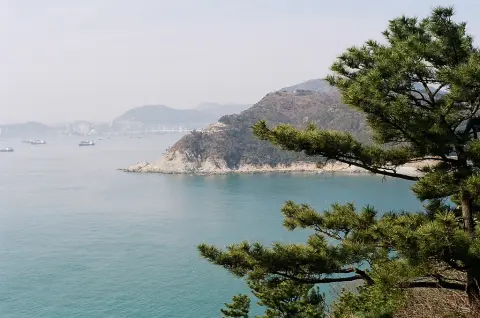
Welcome to Taejongdae. We are at the very southern tip of Yeongdo, where the land ends in tall cliffs and the open sea begins. Pine forest covers the headland, and a looping road runs through it to the lookouts. From the edge, the cliffs drop straight down to waves breaking on dark rock. On a clear day, you can see far out to sea. Locals come here to walk, breathe and watch ships glide in and out of the harbour. We will ride the little road train or walk the loop, and stop at the lighthouse and the rocks below it.
The story of Taejongdae
The name Taejongdae is said to come from King Taejong Muyeol of Silla, who ruled in the seventh century and led Silla toward unifying the Korean peninsula. According to tradition, he came to this headland to practise archery and enjoy the view after his campaigns.
For much of history, the headland was wild and hard to reach. In the modern era, the waters around it became busy shipping lanes into Busan's port, and a lighthouse was built on the cliffs to guide vessels past the point. The current lighthouse building is a modern rebuild, but a light has watched over these waters for over a century.
Taejongdae was opened up as a park in the twentieth century, with a road looping through the forest, and in 2013 it became part of Busan National Geopark. Its cliffs, rock platforms and wave-cut terraces show layers of ancient sediment pushed up and carved by the sea.
The setting
The park covers the forested southern headland of Yeongdo. A road of about four kilometres loops around it, used by the Danubi road train and by walkers. Along the loop are several stops: an observatory, the Yeongdo Lighthouse, and Taejongsa temple. Cliffs of layered rock rise up to around a hundred metres from the sea. Below the lighthouse, broad wave-cut platforms called Sinseonbawi, the rock of the gods, stretch out toward the water. A tall rock nearby, Mangbuseok, is said to look like a woman waiting for her husband to return from sea.
Why it matters
Taejongdae is one of Busan's great natural landmarks. It shows the raw geology that shaped the coast, recognised by the national geopark. It also reflects Busan's role as a port, with ships passing within sight of the cliffs every day. For locals, it is a favourite walk and picnic spot. For visitors, it offers a powerful sense of space and sea, only a short ride from the city's busy heart.
Your walk-through
The stops a guide would take you to, in order.
-
1
Danubi train station
Start at the park entrance, where the little Danubi road train sets off. It makes a loop of about four kilometres, with a few stops. You can hop on and off, or simply walk the loop through the pine forest. Buy your ticket at the booth, as you cannot pay on board. Then settle in and watch the trees go by.
-
2
Taejongdae Observatory
Our first stop is the observatory, perched high above the sea. From the deck you look south over open water. On very clear days, people say you can see as far as Tsushima, one of Japan's islands. Below you, waves crash on the base of the cliffs. Look at the colours of the rock, layer upon layer, stacked like pages of a book.
-
3
Mangbuseok
Near the observatory, look for a tall rock standing alone on the cliffs. This is Mangbuseok. Legend says a woman waited here for her husband to return from the sea, until she turned to stone. Similar stories are told along Korea's coasts, a reminder of the families who waited for fishermen and sailors.
-
4
Yeongdo Lighthouse
Next is the Yeongdo Lighthouse. A light has stood on this point for more than a hundred years, guiding ships into Busan's port. The current building is modern, with a small gallery. Stand by the railing and watch the ships sliding past toward the harbour. It is easy to see why a light was needed on such a sharp headland.
-
5
Sinseonbawi rock platforms
Take the steps down below the lighthouse to the broad rock platforms called Sinseonbawi, the rock of the gods. So the story goes, mountain spirits came down here to play. The rock is layered and grooved by waves. Walk carefully, stay back from the edge, and look up at the cliffs towering above you.
-
6
Taejongsa temple
On your way back, stop at Taejongsa, a small temple tucked into the forest. It is known for its hydrangeas, which flower blue and pink in early summer. Even in autumn and winter, it is a peaceful place to sit for a moment before returning to the entrance.
Things you might not know
- Taejongdae is named, according to tradition, after King Taejong Muyeol of Silla, who is said to have practised archery here.
- The park is part of Busan National Geopark, recognised for its layered sea cliffs.
- Mangbuseok is a rock linked to a legend of a woman waiting for her husband to return from the sea.
Researched November 2026 from: en.wikipedia.org, busan.go.kr, cktravels.com. Fees and hours change, so check on the day.