⭐ Must-see · Haeundae-gu, 15 km from central Busan
Haeundae Beach
By the Tralover editorial team · Fact-checked · How we research
Sand, sea fog and a scholar's name carved in stone
🎧 Listen to this guide · about 6 min
Pop your earphones in and we'll walk you round.
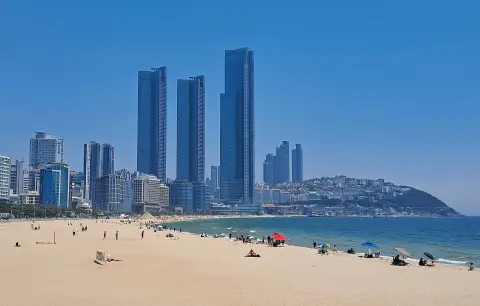
Welcome to Haeundae. Take your shoes off for a moment and feel the sand. In front of you is the open East Sea, wide and blue, and behind you rises a wall of glass towers. It is a strange and lovely mix. On a summer weekend this beach fills with umbrellas from end to end. In late autumn, like now, it belongs to dog walkers, joggers and couples in long coats. Either way, the light here is soft and the waves are steady. We will walk the beach, then slip onto Dongbaekseom, the little wooded headland at the western end. There you will find old stories, a mermaid, and one of the best views of the whole coast.
The story of Haeundae Beach
The name Haeundae goes back more than a thousand years. Tradition says the Silla scholar Choe Chiwon, who used the pen name Haeun, was so taken with this shore that he carved the characters for Haeundae into a rock on Dongbaekseom. That carving still survives, though the sea and wind have worn the middle character away.
For centuries this was a fishing shore. It began to turn into a place of leisure in the late nineteenth century. During Japanese colonial rule, settlers taught their children to swim here, and during the Korean War, American forces were stationed on the beach and used it for landing craft. The beach formally opened in 1965, when it was the largest in the country, and it was named a special tourist zone in 1994.
Success brought problems. Between 1947 and 2004, the sandy area shrank by more than half, so the city now protects it with underwater breakwaters and tops it up with fresh sand each year. In 2005 Busan hosted the APEC summit at Nurimaru on Dongbaekseom, and the world saw this skyline on the evening news.
The setting
The sandy beach runs for about one and a half kilometres and is roughly forty metres wide. At the western end, Dongbaekseom pokes into the sea. It was once a true island, but sediment joined it to the land long ago. Its slopes are covered with pine and camellia trees, and a wooden boardwalk loops around its rocky edge. At the eastern end, the beach meets Mipo, where the old coastal railway has been turned into Haeundae Blue Line Park, with little sky capsules gliding above the shore. Behind the beach stands the LCT tower complex, among the tallest buildings in Korea. Look out to sea and on a clear day you may spot the Oryukdo islets to the southwest.
Why it matters
Haeundae is where Busan comes to breathe. It is the city's front lawn, its party venue and its winter tonic. In January, the Polar Bear Festival, held here since 1988, sees thousands plunge into icy water. In summer the sand festival fills the beach with sculptures, and in autumn the Busan International Film Festival brings stars and outdoor events to this district. For visitors, Haeundae shows modern Busan at its most confident: a working city that has kept a wild sea edge right at its heart.
Your walk-through
The stops a guide would take you to, in order.
-
1
Haeundae Beach main sands
Start in the middle of the beach, near the subway side. Look left and right and you can see the whole sweep of the bay. This sand is partly replenished every year, because storms carried so much of it away over the decades. In 2008 this beach set a Guinness record for the most beach umbrellas in one place. Today, just enjoy the space. Walk close to the waterline, where the sand is firm, and head west toward the green hill of Dongbaekseom.
-
2
Dongbaekseom boardwalk
Here the beach ends and the woods begin. Dongbaek means camellia, and in late winter and early spring these trees flower deep red. Step onto the boardwalk that hugs the rocks. The sea is close now, slapping against dark stone. Pine trees lean out over the water, shaped by years of wind. Take it slowly. The loop is short, but every few steps the view changes, from the beach behind you to the long bridge across the bay ahead.
-
3
Mermaid statue
Down on a rock by the water sits a bronze mermaid. She is Princess Hwangok, from a local folk tale. So the story goes, she came from a far undersea kingdom and married a king here, and on moonlit nights she gazed into a jade bead to see her lost home. It is a gentle legend, and a sad one. People like to photograph her with the waves breaking just beyond.
-
4
Nurimaru APEC House
This low building with the curved roof is Nurimaru. It was built for the 2005 APEC summit, when leaders from across the Pacific Rim met right here. The roof echoes the shape of a traditional Korean pavilion, and the glass walls open straight onto the sea. Inside you can see the round table where the leaders sat. Entry is free, and the views from the terrace toward Gwangan Bridge are some of the finest on this coast.
-
5
Choe Chiwon carved stone
Near the lighthouse observation point is the rock linked to Choe Chiwon. He was one of the great minds of the late Silla kingdom, a scholar who studied in Tang China before returning home. Tradition says he carved the name Haeundae here, and the whole district takes its name from those characters. Look closely. Wind, rain and salt have nearly erased the middle one. A thousand years of weather will do that.
-
6
Dongbaekseom lighthouse and back to the beach
Finish at the small lighthouse platform, where the open sea and the skyline meet. Then follow the path back down to the sand. If it is evening, stay a while. The towers light up one by one, and the sea turns from blue to silver to black. If you still have energy, walk east along the beach toward Mipo and the little sky capsules running along the old rail line.
Things you might not know
- The beach's sandy area shrank by about 54 percent between 1947 and 2004, and the city now adds sand every year.
- In 2008 Haeundae set a Guinness World Record for the most beach umbrellas, 7,937 of them.
- The Haeundae Polar Bear Festival has been held every January since 1988.
Researched November 2026 from: en.wikipedia.org, en.wikipedia.org, koreatodo.com, visitbusan.net. Fees and hours change, so check on the day.