🚗 Day trip · Judean Lowlands (Shephelah), 60 km from central Jerusalem
Beit Guvrin-Maresha National Park
A land of a thousand caves carved by hand
🎧 Listen to this guide · about 6 min
Pop your earphones in and we'll walk you round.
From the outside, it looks like gentle green hills dotted with olive trees. But under your feet, this land is hollow. For thousands of years, people here dug into the soft white chalk, creating quarries, homes, workshops, dovecotes and tombs. Step into one of the great bell caves and look up: the walls curve up and in, like the inside of a giant bell, to a small opening in the roof where a shaft of sunlight falls. Welcome to Beit Guvrin-Maresha National Park, in the Judean Lowlands south-west of Jerusalem. It is cool underground, quiet, and full of surprises. Bring a light jacket for the caves, and be ready for a lot of stairs.
The story of Beit Guvrin-Maresha National Park
The park holds two ancient towns. Maresha, on the higher hill, was an Iron Age town of the kingdom of Judah. It later came under Edomite control, and by the Hellenistic period its people were mostly Idumeans, with Greek and Phoenician influences. It was a busy town, and its residents dug beneath their homes for stone, water and workspace. In 40 BCE Maresha was destroyed by the Parthians.
After that, the nearby town of Beit Guvrin became the main centre of the area. Under the Romans it grew into an important city, and in 200 CE it was renamed Eleutheropolis. The Romans built an amphitheatre here, seating around 3,500 spectators, which was badly damaged by an earthquake in 363. In the Byzantine period a church dedicated to St Anne was built, later rebuilt by the Crusaders in the twelfth century. Much later, Beit Guvrin was the Arab village of Bayt Jibrin, depopulated in 1948.
In 2014 UNESCO listed the site as the Caves of Maresha and Bet-Guvrin in the Judean Lowlands as a Microcosm of the Land of the Caves. The name sums it up: hundreds of caves, of many kinds and many eras, all in one place.
The setting
The park lies in the Shephelah, the rolling lowlands between the Judean Hills and the coastal plain. A thick layer of soft chalk lies under a harder crust, which made it easy to dig caves that would not collapse. On the hill of Tel Maresha, you can climb to the remains of the upper city, with views across the countryside. Around the slopes, marked routes lead to different cave complexes: bell caves, columbaria, oil presses, cisterns and burial caves. Near the park entrance stand the Roman amphitheatre and the Crusader church ruins of Beit Guvrin.
Why it matters
Few places show so clearly how people have adapted to and shaped the land over thousands of years. The caves record everyday life, from olive oil production and pigeon raising to burial customs, across Judean, Hellenistic, Roman, Byzantine and early Islamic times. Archaeologists continue to dig here, and the site is a favourite for families and school groups. For visitors, it is a quieter and very different side of the region from the holy places of Jerusalem.
Your walk-through
The stops a guide would take you to, in order.
-
1
The Bell Caves
Start at the Bell Caves, the park's most famous sight. There are about 800 bell-shaped caves at the site, many linked by passages. Workers dug down through a small hole in the hard upper crust, then widened the cave as they cut into the soft chalk below, quarrying stone as they went. Quarrying peaked in the Hellenistic, Byzantine and early Arab periods. Stand in the centre and look up at the beam of light. The acoustics are wonderful, and concerts are sometimes held here.
-
2
The Columbarium Cave
Next, visit one of the columbarium caves. The walls are lined with hundreds of small square niches, row upon row. These were dovecotes, built to raise pigeons. People used pigeons for meat, for their droppings as fertiliser, and possibly for religious offerings. It is a remarkable sight, like a honeycomb carved in stone. See how carefully each niche is cut, and imagine the noise of the birds.
-
3
The Polish Cave
Look for the Polish Cave, another columbarium with a central pillar. On the pillar is an inscription carved by Polish soldiers who visited during the Second World War, while serving in the region. It is a small, touching trace of travellers from far away who also stood here and wondered at these caves. Take a moment to find the carving before you move on.
-
4
The Sidonian Burial Caves
Now head to the Sidonian Burial Caves, the family tomb of a man named Apollophanes. These are the only painted caves at the site. Along the walls are burial niches, and above them painted animals, both real and mythical, such as a rooster, the three-headed dog Cerberus and a phoenix. The paintings have been restored, but they still give you a rare glimpse of how people decorated their tombs more than two thousand years ago.
-
5
The Roman amphitheatre
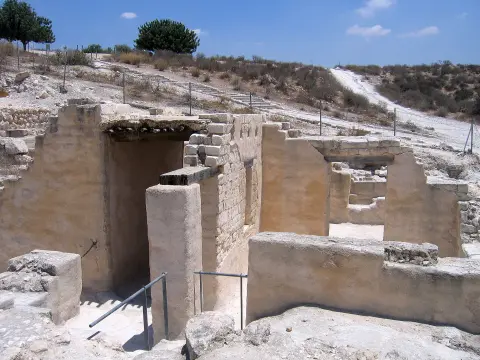
Finish near the entrance at the Roman amphitheatre of Eleutheropolis. Built in the second century, it could seat about 3,500 people for games and shows. Walk through the arched entrances and stand in the arena. An earthquake in 363 brought much of it down. Nearby, you can also see the ruins of the Church of St Anne, with its tall Crusader-era apse still standing among the fields.
Things you might not know
- The site has about 800 bell-shaped caves, many linked by underground passages.
- The Roman city here was renamed Eleutheropolis in 200 CE.
- The Sidonian Burial Caves are the only painted caves at the site.
Researched November 2026 from: whc.unesco.org, en.wikipedia.org, timeout.com. Fees and hours change, so check on the day.