⭐ Must-see · Old City, 2 km from central Jerusalem
Old City of Jerusalem
Four quarters, one wall, and centuries underfoot
🎧 Listen to this guide · about 7 min
Pop your earphones in and we'll walk you round.
Welcome to the Old City. Stand for a moment inside Jaffa Gate and listen. Church bells, a call to prayer, a shopkeeper calling out the price of pomegranate juice, the scrape of a handcart on smooth stone. All of it inside a walled square of less than one square kilometre. People have lived, prayed and argued on this ground for thousands of years, and you can feel it in the polished steps and narrow lanes. Today we will cross the four quarters, Armenian, Jewish, Muslim and Christian, and you will notice how quickly the language, the food and the shop signs change from one street to the next. Keep your bag close, wear good shoes, and let yourself get a little lost. That is part of the pleasure here.
The story of Old City of Jerusalem
Jerusalem's story reaches back to the Bronze Age, and the walled city you see today sits on layer after layer of older towns. Rulers came and went: Judean kings, Babylonians, Persians, Greeks, Romans, Byzantines, early Muslim dynasties, Crusaders, Ayyubids, Mamluks and Ottomans. Each left something behind, from Roman street plans to Crusader churches and Mamluk doorways.
The walls themselves are Ottoman. Sultan Suleiman the Magnificent had them built between 1535 and 1542. They run for about four and a half kilometres, stand between five and fifteen metres high and include thirty-five towers. Suleiman's wall had six gates. The New Gate was added in 1887, and in 1898 a gap was opened beside Jaffa Gate so that the German emperor Wilhelm the Second could ride into the city.
The idea of four quarters is surprisingly recent. It seems to date from British maps drawn in the 1840s, and the real boundaries are blurred and uneven. A fifth neighbourhood, the Mughrabi Quarter beside the Western Wall, was demolished in 1967. In 1981 the Old City and its walls were added to UNESCO's World Heritage List, and since 1982 they have been on its list of sites in danger. The status of the city is politically contested, so check official travel advice before you go.
The setting
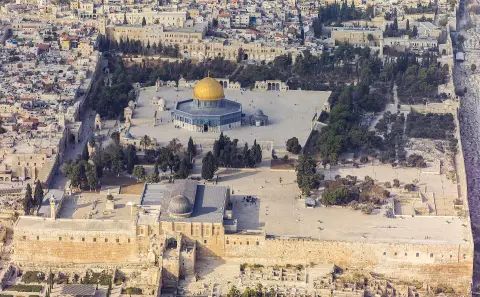
The Old City sits on a set of low hills, cut by the Kidron Valley to the east and the Hinnom Valley to the south and west. The Temple Mount, known to Muslims as al-Haram al-Sharif, fills the south-eastern corner as a vast raised platform. The Christian Quarter climbs the north-west around the Church of the Holy Sepulchre. The Muslim Quarter, the largest, spreads across the north-east. The Armenian Quarter occupies the south-west behind high monastery walls, and the Jewish Quarter lies to the south-east, above the Western Wall. Two main market streets cross the city, roughly following the lines of the Roman city plan. Almost everything is built of pale Jerusalem limestone, which glows gold in late afternoon light.
Why it matters
Few places on earth matter to so many people at once. For Jews, the Old City holds the site of the ancient Temples and the Western Wall. For Christians, it is where Jesus was crucified, buried and, they believe, rose again. For Muslims, it is the place of the Prophet Muhammad's Night Journey and home to the Al-Aqsa Mosque, the third holiest site in Islam. Around thirty thousand people still live inside the walls, so this is a living neighbourhood, not a museum. Respect prayer times, dress modestly in holy places, and remember that each community here sees the city through its own story.
Your walk-through
The stops a guide would take you to, in order.
-
1
Jaffa Gate
We begin at Jaffa Gate, the main entrance from the west. Look at the gate's L-shaped passage. Ottoman builders turned the path at a sharp angle so attackers could not charge straight in. Now look to the right of the gate at the wide gap in the wall. That opening was cut in 1898 for the visit of Kaiser Wilhelm the Second, and today cars and buses use it. From here, the old road ran west to the port of Jaffa, which is how the gate got its name.
-
2
Tower of David citadel
Just inside the gate rises the citadel known as the Tower of David. Despite the name, it has nothing to do with King David's time. The base of one tower goes back to Herod the Great, and the slender minaret you see was added by the Ottomans in the seventeenth century. Inside is the Tower of David Jerusalem Museum, which tells the city's story from its earliest days. If you have time, climb the ramparts here for one of the best views over the rooftops.
-
3
Armenian Quarter and St James Cathedral
Follow the road south and you enter the Armenian Quarter, quieter and enclosed by high walls. Armenians have lived in Jerusalem since the early centuries of Christianity. Their great Cathedral of St James, largely from the twelfth century, is hung with oil lamps and lined with blue tiles. It is usually open only for short periods around the afternoon service, so check the time before you go. Walk softly here. This is a residential monastery compound, not a showpiece.
-
4
The Cardo and Hurva Square
Now we cross into the Jewish Quarter. Step down into the Cardo, the main street of Byzantine Jerusalem, uncovered by archaeologists after 1967. Some of its tall stone columns have been set back upright, and part of the street is now a covered shopping arcade. A few steps away is Hurva Square, with its white domed synagogue. The Hurva was destroyed in the fighting of 1948 and rebuilt in 2010. The square is a favourite place for families to rest in the shade.
-
5
Damascus Gate and the Muslim Quarter souq
Make your way north through the covered market streets into the Muslim Quarter. Here the lanes are full of spice sellers, sweet shops stacked with knafeh, and sellers of fresh bread rings sprinkled with sesame. At the northern edge you reach Damascus Gate, the grandest of Suleiman's gates, with its battlements and carved stonework. Sit on the steps outside the gate for a few minutes in the late afternoon. It is one of the best places in the city to simply watch daily life go by.
-
6
Christian Quarter and the Ramparts Walk
We finish in the Christian Quarter, where shops sell olive wood carvings, icons and candles for pilgrims heading to the Holy Sepulchre. If your legs allow it, buy a ticket for the Ramparts Walk near Jaffa Gate. The northern route takes you along the top of Suleiman's wall towards Lions' Gate, looking down into courtyards, rooftop gardens and school yards that you would never see from the street. It is the best way to understand how the four quarters fit together.
Things you might not know
- The Old City covers only about 0.9 square kilometres, yet it holds sites sacred to Judaism, Christianity and Islam.
- The gap beside Jaffa Gate was opened in 1898 for the German emperor Wilhelm II's state visit.
- The division into four quarters is a convention that appears to date from British maps of the 1840s.
Researched November 2026 from: whc.unesco.org, en.wikipedia.org, en.wikipedia.org, tod.org.il. Fees and hours change, so check on the day.