🚗 Day trip · Jaffa, Tel Aviv-Yafo, 65 km from central Jerusalem
Old Jaffa
An ancient harbour town above the Mediterranean
🎧 Listen to this guide · about 6 min
Pop your earphones in and we'll walk you round.
After the stone and hills of Jerusalem, here is the sea. Climb the little hill of Old Jaffa and the Mediterranean spreads out below you, sparkling and blue, with fishing boats in the harbour and the white towers of Tel Aviv curving along the beach to the north. Sea breezes blow through narrow alleys lined with galleries. A clock tower stands over the square, and from somewhere comes the smell of fresh bread and grilled fish. Jaffa is one of the oldest ports in the world, and its story is full of kings, prophets, sailors and legends. Wander slowly, follow the stairways down to the water, and stay for the sunset over the sea.
The story of Old Jaffa
Jaffa sits on a natural sandstone hill about 40 metres above the shore, and people have lived here since at least the Bronze Age. Around the fifteenth century BCE it was conquered by the Egyptian pharaoh Thutmose the Third, and an ancient Egyptian tale tells how his soldiers took the town by hiding in baskets carried through the gates. In the Hebrew Bible, the prophet Jonah sets sail from Jaffa, and cedar wood for the Temple in Jerusalem was said to arrive through its port. In the Acts of the Apostles, Peter raises a woman named Tabitha, also called Dorcas, and stays at the house of Simon the Tanner here.
Greek legend placed the story of Andromeda, chained to a rock to be offered to a sea monster, on the rocks off the harbour. In March 1799, Napoleon's army captured and sacked the town. Afterwards, the Ottoman governor Muhammad Abu-Nabbut rebuilt much of it, including the Mahmoudiya Mosque. The city walls were pulled down in the 1870s, and in 1903 a clock tower was completed to honour the reign of Sultan Abdul Hamid the Second.
In 1948 most of Jaffa's Arab population fled or were expelled, and in 1950 Jaffa was merged with Tel Aviv into one city. Old Jaffa was later restored as a quarter of galleries, studios and restaurants.
The setting
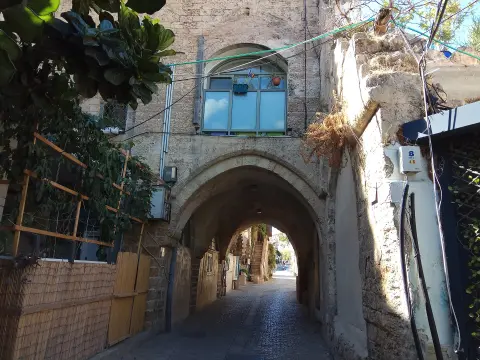
Old Jaffa occupies a compact hill at the southern end of Tel Aviv's long seafront. At the bottom of the hill stands the Clock Tower Square, with the old Ottoman buildings around it and the flea market spreading out to the south-east. On top of the hill is Kedumim Square and the Franciscan Church of St Peter, with the Hill of Jaffa park and its lookouts beside it. A maze of narrow, restored stone alleys, many named after the signs of the zodiac, winds down towards the harbour. The working fishing port lies on the western side, with warehouses turned into cafes and shops.
Why it matters
Jaffa is part of the story of all the region's peoples. Jews, Christians and Muslims each have traditions linked to its port, and its Arab, Jewish and international residents give it a mixed and lively character. Its old harbour was for centuries the gateway through which pilgrims and travellers reached Jerusalem. Today it is a favourite place for an evening stroll, with art galleries, fish restaurants and the best sunset views on this stretch of coast.
Your walk-through
The stops a guide would take you to, in order.
-
1
The Clock Tower
Start at the Clock Tower, in the square at the foot of the hill. Its foundation stone was laid in 1900, and the tower was completed in 1903 to mark twenty-five years of Sultan Abdul Hamid the Second's reign. Several towns in the Ottoman Empire built similar towers for the same anniversary. Look at its pale stone and the clock faces on each side. Around the square stand old Ottoman buildings, including the former government house.
-
2
The Mahmoudiya Mosque
Just by the square is the Mahmoudiya Mosque, Jaffa's largest, with its white minaret. It was built in the early nineteenth century under the governor Abu-Nabbut, when he rebuilt the town after Napoleon's siege. Look for the public drinking fountain set in its outer wall, a gift to thirsty travellers. If you wish to enter, ask first and avoid prayer times. Modest dress is needed.
-
3
Kedumim Square and St Peter's Church
Climb up to Kedumim Square, at the top of the hill. Here stands the Franciscan Church of St Peter, built in the late nineteenth century, its brown facade and bell tower looking out over the sea. It honours the apostle Peter's stay in Jaffa. Below the square is a small visitor centre with excavated remains of the ancient town. Look out over the rooftops to the coastline curving north towards Tel Aviv.
-
4
The Wishing Bridge and the zodiac alleys
Walk into the Hill of Jaffa park and find the small Wishing Bridge, decorated with the signs of the zodiac. A local custom says that if you touch your own sign and look out to sea, your wish will come true. Then wander down the narrow stone alleys, each named after a sign of the zodiac. They are lined with artists' studios and galleries, and every turn reveals a glimpse of the sea.
-
5
Jaffa Port and Andromeda's Rock
Follow the stairs down to Jaffa Port, where fishing boats still unload and old warehouses now house cafes and shops. Look out past the breakwater to a cluster of rocks in the sea. These are known as Andromeda's Rock, where, legend says, the princess Andromeda was chained before the hero Perseus rescued her. Stay by the water to watch the sun set over the Mediterranean, the perfect end to a day in Jaffa.
Things you might not know
- Old Jaffa stands on a natural sandstone hill about 40 metres above the sea.
- The Jaffa Clock Tower was completed in 1903 for the silver jubilee of Sultan Abdul Hamid II.
- Jaffa and Tel Aviv were merged into a single city in 1950.
Researched November 2026 from: en.wikipedia.org, en.wikipedia.org, timeout.com. Fees and hours change, so check on the day.