💎 Hidden gem · South-west Jerusalem, 8 km from central Jerusalem
Ein Karem
Bell towers, cypress trees and a spring in the hills
🎧 Listen to this guide · about 6 min
Pop your earphones in and we'll walk you round.
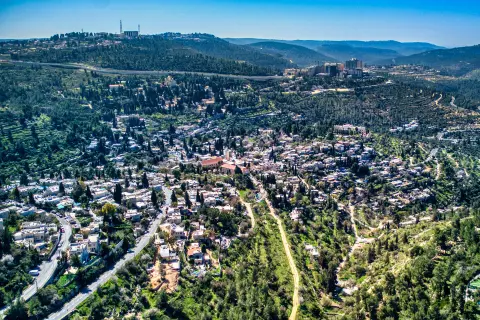
Leave the city behind and drop down into a green valley. Stone houses climb the hillsides between olive trees and cypresses. Church bells ring across the slopes, and from a terrace cafe someone waves you over for coffee. This is Ein Karem, a former village now part of Jerusalem. Its name is usually translated as the spring of the vineyard, and the spring is still here. For Christians, this is the hometown of John the Baptist and the place where Mary came to visit her cousin Elizabeth. For everyone, it is one of the loveliest corners of Jerusalem for a slow wander. Bring comfortable shoes. Everything here is either uphill or downhill, and every turn gives you a new view.
The story of Ein Karem
People have lived around this spring for a very long time. Pottery from the Middle Bronze Age has been found nearby, and a ritual bath, or mikveh, shows there was a Jewish settlement here in the Second Temple period. From early Christian times, pilgrims linked the village with the birth of John the Baptist and with the Visitation, when Mary visited Elizabeth, as told in the Gospel of Luke.
The Crusaders built the first church dedicated to St John here. The Franciscans bought the site in 1621 and rebuilt their church and monastery by the end of that century. In 1871 the Russian Orthodox mission founded the Gorny Convent on the hillside, and its Church of Our Lady of Kazan was consecrated in 1873. The present Church of the Visitation was completed in 1955, designed by the Italian architect Antonio Barluzzi over older Byzantine remains.
Under Ottoman and British rule, Ein Karem was a Palestinian Arab village of a few thousand people. In July 1948, during the war, it was captured by Israeli forces, most residents fled, and the village was depopulated. Afterwards it became part of Jerusalem and was resettled by new immigrants. Artists and craftspeople later moved in, and in 1961 the large Hadassah medical centre opened on a nearby hilltop.
The setting
Ein Karem lies in a valley on the south-western edge of the city, surrounded by forested hills. The heart of the village is the main street running past the spring. From there, two churches face each other across the valley. On the north side, the Church of St John the Baptist rises above the old houses. On the southern slope, a long stepped path climbs to the Church of the Visitation. Higher still, the gilded onion domes of the Gorny Convent shine among pines. The lanes are lined with old stone houses, galleries, small restaurants and gardens heavy with bougainvillea.
Why it matters
Ein Karem is one of the most important Christian pilgrimage places around Jerusalem, as the birthplace of John the Baptist and the setting for the Magnificat, the song of praise that Luke's Gospel gives to Mary. It also carries layers of memory for others: the old mosque near the spring recalls the Arab village, while the modern neighbourhood is home to Israeli families, artists and students. Today it is loved by Jerusalemites as a weekend escape, with good food, views and walking trails into the surrounding hills.
Your walk-through
The stops a guide would take you to, in order.
-
1
Mary's Spring
Start in the village centre at Mary's Spring. Christian tradition says Mary drank here on her visit to Elizabeth, a tradition dating back to at least the fourteenth century. Water still trickles from a stone outlet. Above it stands a small mosque with a minaret, dated to 1828 and 1829, a reminder of the village's past. Look around at the old stone houses and terraces. This spring is why people settled here in the first place.
-
2
Church of the Visitation
From the spring, follow the steep lane uphill to the Church of the Visitation. It is a good climb, so take it slowly. In the courtyard, look at the wall covered in tiles bearing the words of the Magnificat in dozens of languages. See if you can find yours. Antonio Barluzzi's church, completed in 1955, has bright frescoes inside. In the lower chapel, a rock is honoured by tradition as the stone that hid the infant John.
-
3
The village lanes
Wander back down and spend some time in the lanes. Ein Karem is full of artists' studios, small galleries and cafes with terraces looking across the valley. Many of the old stone houses have arched windows and iron balconies. On weekends Jerusalem families come for brunch and a stroll. Stop for coffee, a slice of cake or a plate of something local, and simply enjoy the view of the church towers above the trees.
-
4
Church of St John the Baptist
Now cross to the north side of the valley and climb to the Franciscan Church of St John the Baptist, with its tall bell tower. Inside, steps lead down to a grotto honoured as the birthplace of John. Around the courtyard, tiled plaques carry the Benedictus, the song of John's father Zechariah, in many languages. The Franciscans have cared for this site since 1621. Look for remains of older mosaics near the entrance.
-
5
View of the Gorny Convent
Finally, look up the southern slopes for the golden onion domes of the Gorny Convent, the Russian Orthodox monastery founded in 1871. It is a working convent, and visits are limited, so enjoy it mostly from the outside or ask locally about access. If you still have energy, Hadassah Ein Kerem hospital on the hill above has a synagogue with twelve stained-glass windows by Marc Chagall, representing the twelve tribes of Israel.
Things you might not know
- The name Ein Karem is usually translated as spring of the vineyard, in both Hebrew and Arabic.
- The Church of the Visitation, completed in 1955, was designed by the Italian architect Antonio Barluzzi.
- The Franciscans bought the site of the Church of St John the Baptist in 1621.
Researched November 2026 from: en.wikipedia.org, cicts.org, itraveljerusalem.com. Fees and hours change, so check on the day.