⭐ Must-see · Old City, Jewish Quarter, 3 km from central Jerusalem
Western Wall
Ancient stones, folded prayers, and voices rising day and night
🎧 Listen to this guide · about 6 min
Pop your earphones in and we'll walk you round.
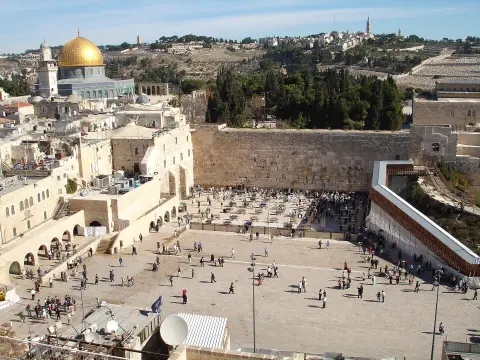
Come down the steps slowly and let the plaza open up in front of you. There it is: the Western Wall, the Kotel in Hebrew, its great pale blocks rising above a crowd of people at prayer. Some rock gently back and forth over prayer books. Others simply rest a hand or a forehead against the stone. Look closely and you will see the cracks stuffed with tiny folded notes, thousands of them, left by people from every corner of the world. The plaza is open day and night, all year, and it is never truly silent. Whether you come to pray or simply to watch, you are welcome. Just move quietly, dress modestly, and give the worshippers room.
The story of Western Wall
Around 19 BCE, Herod the Great began a vast rebuilding of the Second Temple. To create a level platform on the uneven hill, his engineers built enormous retaining walls and filled the space inside. The Western Wall is part of that western retaining wall. In 70 CE, Roman forces destroyed the Temple during the First Jewish–Roman War, but much of the retaining wall survived.
Over the following centuries the wall became the focus of Jewish prayer and mourning, because it is the closest accessible point to the place where the Temple's inner sanctuary once stood. Later builders added higher courses in the Umayyad and Ottoman periods, which is why the stones change size as your eye travels upward. In Islamic tradition, this same stretch is known as the Al-Buraq Wall, linked to the Prophet Muhammad's Night Journey.
For centuries, worshippers stood in a narrow lane only a few metres wide, hemmed in by the houses of the Mughrabi Quarter. After the 1967 war those houses were demolished and the large open plaza was created, which can now hold huge crowds on festivals. Excavations along the wall, above and below ground, have continued ever since.
The setting
The full western retaining wall is about 488 metres long, but most of it is hidden behind later buildings. The open prayer section facing the plaza is about 57 metres long. From its foundations the wall rises around 32 metres, with roughly 19 metres visible above ground. Of its 45 courses of stone, 17 lie below today's street level. The prayer area is divided by a screen, with the larger men's section to the left and the women's section to the right. To the left, under Wilson's Arch, a covered prayer hall shelters scrolls and worshippers. South of the plaza, beyond a ramp, the archaeological park around Robinson's Arch exposes paving stones from the Herodian street.
Why it matters
For Jews around the world, this is the most sacred place where prayer is permitted today, and the focus of prayers on festivals, family celebrations and days of mourning. Children celebrate their bar mitzvah here, soldiers take oaths, and people come in their grief. Many follow a long custom of placing written prayers in the cracks. The notes are gathered twice a year and buried respectfully on the Mount of Olives, never thrown away. For Muslims the wall forms part of the boundary of al-Haram al-Sharif, and for many visitors of all faiths it is a place of quiet reflection.
Your walk-through
The stops a guide would take you to, in order.
-
1
The plaza entrance
After the security check, pause at the top of the plaza. From here you see the whole scene: the wall, the dividing screen, and above it the golden Dome of the Rock peeking over the top. This view shows you how closely the holy places of different faiths sit together. Notice the stone basins near the entrance. Observant visitors wash their hands here before approaching. If you are a man, you can borrow a paper head covering from a stand nearby.
-
2
The prayer section
Walk forward to the wall itself. Look at the lowest courses, the biggest stones with their neat flat margins and slightly raised centres. That is classic Herodian masonry, more than two thousand years old. Higher up, the smaller blocks were added much later. Plants grow from the joints, and birds nest in the gaps. If you wish, write your own short note and tuck it into a crack. When you leave, many people step backwards a few paces, so as not to turn their back on the wall.
-
3
Wilson's Arch
On the far left of the men's section is a vaulted hall under Wilson's Arch. This arch once carried a bridge and road from the upper city across to the Temple platform. Today it shelters an indoor prayer area, with shelves of prayer books and Torah scrolls. Women can look in from a viewing area. In winter rain or summer heat, many worshippers prefer to pray here. Look up and you can see how the arch springs straight out of the ancient wall.
-
4
Western Wall Tunnels
To the left of the plaza is the entrance to the Western Wall Tunnels. On a guided tour you walk underground along the hidden length of the wall, past ancient water channels and Second Temple period streets. The highlight is one of the largest building stones ever found in the region, about 13.5 metres long and weighing an estimated 250 to 300 tonnes. Tours run only with a guide and must be booked in advance, so reserve as early as you can.
-
5
Robinson's Arch and the archaeological park
Finish south of the prayer plaza, in the Jerusalem Archaeological Park beside the Davidson Center. Here you can see the stump of Robinson's Arch jutting from the wall. It once supported a grand staircase leading up to the Temple platform. At its foot lie heavy stones that fell onto the Herodian street below, apparently in the Roman destruction of 70 CE. It is a sobering sight, and it helps you picture how high the whole complex once stood.
Things you might not know
- Only about 57 metres of the wall's roughly 488-metre length is exposed at the prayer plaza.
- Seventeen of the wall's 45 courses of stone lie below today's ground level.
- The prayer notes left in the cracks are collected twice a year and buried on the Mount of Olives.
Researched November 2026 from: en.wikipedia.org, english.thekotel.org, english.thekotel.org. Fees and hours change, so check on the day.