⭐ Must-see · Old City, Christian Quarter, 2 km from central Jerusalem
Church of the Holy Sepulchre
Candles, chants and ancient stone around an empty tomb
🎧 Listen to this guide · about 6 min
Pop your earphones in and we'll walk you round.
Step through the low doorway and let your eyes adjust to the dark. Incense hangs in the air. Somewhere a choir is chanting in Greek, somewhere else in Armenian, and from a side chapel comes a Latin hymn. Pilgrims kneel to kiss a slab of stone. Others queue patiently with candles in their hands. This is the Church of the Holy Sepulchre, the place Christians have honoured for nearly seventeen centuries as Golgotha, where Jesus was crucified, and as the tomb where he was buried and, they believe, rose again. It can feel crowded and a little chaotic at first. Give it time. Find a quiet corner, watch the rituals, and you will begin to feel why people cross the world to stand here.
The story of Church of the Holy Sepulchre
Around 326, the Roman emperor Constantine ordered a church built at this spot, and Christian tradition credits his mother Helena with identifying the holy places. The grand church was consecrated on 13 September 335. It suffered fire and damage over the centuries, and on 18 October 1009 the Fatimid caliph al-Hakim ordered it destroyed. A partial reconstruction was completed in 1048 under the Byzantine emperor Constantine the Ninth Monomachos.
Crusaders took Jerusalem in July 1099 and remodelled the church, bringing the separate holy places under one roof. Their work was completed in 1149 during the reign of Queen Melisende, and much of the building you see is still theirs. In 1808 a fire caused the rotunda dome to collapse, and the rotunda and the shrine over the tomb, called the Aedicule, were rebuilt in 1809 and 1810.
The church is shared under an arrangement known as the Status Quo, dating from 1757 and confirmed by an Ottoman decree in 1853. Even small changes need agreement between the communities. That is why a careful restoration of the Aedicule, carried out from 2016 to 2017, was such a notable event. In October 2016 the marble covering the burial bed was lifted for the first time since at least 1555.
The setting
From the outside, the church hides behind a small stone courtyard and a twin-arched Crusader facade, one of its doorways long since walled up. Inside, the building is a maze of chapels on different levels. Just past the entrance, steep stairs on the right climb to Calvary, the rock of Golgotha. Straight ahead lies the Stone of Anointing. To the left opens the great Rotunda, a domed circle with the Aedicule at its centre. East of it is the Catholicon, the Greek Orthodox central church under a second dome. Stairs lead down to Armenian and Catholic chapels cut into an old quarry, and on the roof sits a small Ethiopian monastery.
Why it matters
The church is shared by the Greek Orthodox, Roman Catholic and Armenian Apostolic churches, with the Coptic, Ethiopian and Syriac Orthodox churches holding smaller rights. Each keeps its own chapels, services and timetable. Remarkably, the keys have long been held by a Muslim family, the Joudeh, and another Muslim family, the Nuseibeh, serve as doorkeepers, a role documented since the twelfth century. Every Easter the church becomes the heart of Christian celebration in Jerusalem, and all year it draws pilgrims from every tradition.
Your walk-through
The stops a guide would take you to, in order.
-
1
The courtyard and facade
Before you go in, stand in the courtyard and look up at the facade. Above the main door, under the right-hand upper window, you will see a small wooden ladder resting on a ledge. It has stood there for generations, and because of the Status Quo no single community can move it. It has become a gentle symbol of how carefully everything here is shared. The left-hand doorway was sealed centuries ago, so everyone now enters through one door.
-
2
Calvary
Just inside, turn right and climb the steep stone stairs to Calvary. This raised platform is traditionally the place of the crucifixion. The Greek Orthodox altar on the left stands over the rock itself, and under the altar you can reach through a silver disc to touch it. Look behind glass panels to see the bare rock. The Catholic chapel on the right has a fine mosaic ceiling. Below this floor, the Chapel of Adam shows a crack in the rock.
-
3
Stone of Anointing
Come back down to the flat slab of reddish stone near the entrance, with lamps hanging above it. Tradition holds that this is where Jesus's body was prepared for burial. The tradition here goes back to Crusader times, and the present slab dates from the rebuilding after the 1808 fire. Watch the pilgrims kneel, lay out scarves and rosaries, and rub them on the stone to take the blessing home. The mosaic on the wall behind shows the scene.
-
4
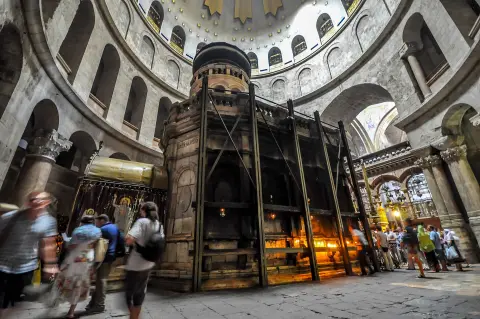
The Rotunda and the Aedicule
Now walk left into the Rotunda. Under the great dome stands the Aedicule, the small shrine built over the tomb. Its present form dates from 1810, and it was restored and strengthened in 2016 and 2017. Inside are two tiny rooms: the Chapel of the Angel, then the burial chamber itself, with room for only a few people at a time. The queue can be long, and the priests keep it moving, so be ready. At the back of the Aedicule is a small Coptic chapel.
-
5
The Catholicon
Facing the Aedicule's entrance, step into the Catholicon, the Greek Orthodox church at the centre of the complex. Look for the stone chalice on the floor. It is known as the Omphalos, and in an old Christian tradition it marks the centre of the world. Lift your eyes to the dome and the gilded iconostasis, the screen of icons that separates the altar. During services the singing here can fill the whole building.
-
6
Chapel of St Helena
Finally, follow the ambulatory round to the stairs going down. The walls are scratched with hundreds of small crosses, carved by medieval pilgrims. At the bottom is the Armenian Chapel of St Helena, and lower still a rough cave where tradition says Helena found the True Cross. This part of the site was once a quarry, a reminder that in Jesus's time this area lay just outside the city walls.
Things you might not know
- The church was first consecrated in 335, under the emperor Constantine.
- A Muslim family has held the church's keys since the time of Saladin, according to long tradition.
- In October 2016 the marble over the burial bed was lifted for the first time since at least 1555.
Researched November 2026 from: en.wikipedia.org, cicts.org, whc.unesco.org. Fees and hours change, so check on the day.