⭐ Must-see · Mahane Yehuda, between Jaffa Road and Agrippas Street, 1 km from central Jerusalem
Mahane Yehuda Market
Halva, spices and Friday crowds in the city's market
🎧 Listen to this guide · about 6 min
Pop your earphones in and we'll walk you round.
Follow your nose. Before you even reach the gate, you will smell it: warm bread, coffee, cumin, and the sweet scent of ripe fruit. Welcome to Mahane Yehuda, the shuk, where Jerusalem comes to shop. Sellers shout their prices in Hebrew and Arabic. A man hands you a sliver of sesame halva to try. An elderly woman pulls her shopping trolley through the crowd with total confidence. By day this is a working market full of fish, cheese, olives and pastries. After dark the shutters come down, and the same lanes fill with bars, music and late dinners. Come hungry, carry some cash, and say yes when someone offers you a taste.
The story of Mahane Yehuda Market
The neighbourhood of Mahane Yehuda was founded in 1887, outside the walls of the Old City, by three partners. It was named after Yehuda, the brother of one of them, Joseph Navon. At the end of the nineteenth century, Arab traders and farmers began selling produce on an empty lot nearby, and a market grew up under the name Shuk Beit Yaakov, after a neighbouring quarter.
In the late 1920s, the British Mandate authorities cleared the informal stalls and built permanent ones with roofing, and the market took the name it carries today. Through the twentieth century it remained the place where ordinary Jerusalemites bought their fruit, vegetables, meat and fish, especially before Shabbat.
From the 2000s, the market changed character. Cafes, bakeries, boutique food shops and bars moved in alongside the old family stalls. Restaurants opened in tiny spaces between the vegetable sellers, and live music began to fill the alleys at night. In 2015 a young artist, Solomon Souza, started painting portraits onto the metal shop shutters, so that when the stalls close, the market becomes an open-air gallery. By mid-2016 he had painted more than 250 of them.
The setting
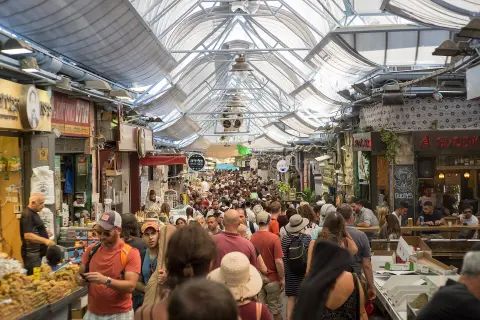
The market fills a rectangle of streets between Jaffa Road to the north and Agrippas Street to the south. Two main lanes run through it. Etz Haim Street, the covered market, runs under a metal roof and is the busiest part, lined with produce, bakeries and spice stalls. Mahane Yehuda Street, the open-air market, runs parallel and feels a little more relaxed. Between them are narrow alleys named after fruits and trees, such as the Street of the Apple and the Street of the Nut. Around the edges, small restaurants and grill bars spill out onto Agrippas Street. The light rail stops right outside on Jaffa Road.
Why it matters
Mahane Yehuda is where you meet the city as it really lives. Religious and secular Jerusalemites, students, families, older shoppers and tourists all come here, especially on Thursday nights and Friday mornings before Shabbat. The food tells the story of the people who settled in Jerusalem from Iraq, Morocco, Kurdistan, Yemen, Georgia and Europe. It is also one of the liveliest places for evening life in western Jerusalem. Bargaining is gentle, tasting is normal, and a good conversation with a stallholder is often the best souvenir.
Your walk-through
The stops a guide would take you to, in order.
-
1
Jaffa Road entrance
Start on Jaffa Road, near the light rail stop, and enter the covered market on Etz Haim Street. Look up and you will see the metal roof that keeps out the rain and the summer sun. The noise rises immediately. This first stretch is full of fruit and vegetable stalls, piled with whatever is in season: pomegranates in autumn, citrus in winter, cherries and apricots in early summer. Notice how the sellers polish and stack their fruit into neat pyramids.
-
2
Halva and spice stalls
Keep walking and you will reach the halva sellers, with great blocks of sesame paste flavoured with pistachio, chocolate, coffee or rose. They will happily cut you a taste. Next door, spice merchants keep open sacks of za'atar, sumac, turmeric and mixes for meat and rice. Ask for hawaij, a Yemenite blend for soup and coffee. A small bag of spices is light to carry and a lovely way to bring the market home.
-
3
The bakeries
Look for the bakeries selling rugelach, small rolled pastries dripping with chocolate, and the round braided challah bread that families buy for Shabbat. On Fridays the queues can stretch into the lane. Elsewhere you will find Iraqi and Kurdish pastries, sesame-topped breads and stuffed savoury pastries. Buy something warm, step out of the flow of shoppers, and eat it right there. That is how locals do it.
-
4
The side alleys
Turn into one of the narrow side alleys that connect the two main streets. Many are named after fruits, nuts and trees. Here you find olive sellers, cheese shops, fishmongers and small family eateries serving soups and stews to market workers at long-established counters. It is quieter, and you can watch the deliveries arriving on handcarts. Keep an eye out for small courtyards and old stone houses from the early days of the neighbourhood.
-
5
The painted shutters
Come back after the stalls close, or on a Friday afternoon as the market shuts for Shabbat, and walk Etz Haim Street again. The metal shutters, rolled down, show painted portraits by Solomon Souza and other artists: rabbis, poets, scientists, biblical figures and local characters. The market becomes a gallery. Later in the evening, the bars open their doors, the music starts, and the whole place feels like a street party.
Things you might not know
- The Mahane Yehuda neighbourhood was founded in 1887 and named after Yehuda Navon, the brother of one of its founders.
- The British Mandate authorities built the first permanent roofed stalls in the late 1920s.
- By July 2016, artist Solomon Souza had painted more than 250 of the market's roughly 360 shop shutters.
Researched November 2026 from: en.wikipedia.org, itraveljerusalem.com. Fees and hours change, so check on the day.